
Medication Titration Side-Effect Logger
Instructions: Use this tool to record your daily experience during titration. Concrete data (1-10 scale) helps your doctor decide if a dose increase is safe or premature.
Your Titration Log
Ever wondered why your doctor starts you on a tiny dose of a new medication, only to tell you they'll increase it every week? It feels slow, and when you're dealing with symptoms, slow is the last thing you want. But jumping straight into a full dose is often a recipe for disaster. Many medications, if taken at full strength immediately, can trigger intense nausea, anxiety, or even dangerous systemic reactions that make you want to quit the treatment entirely.
The solution is a process called dose titration is the systematic process of adjusting a medication dosage to achieve the best possible therapeutic benefit while keeping adverse effects to a minimum. Instead of a "one size fits all" approach, titration treats your body like a unique chemistry experiment, finding the exact point where the drug works without making you feel miserable. This "start low and go slow" method isn't just a suggestion; it's a clinical necessity for drugs with a narrow therapeutic index, where the line between a helpful dose and a toxic one is dangerously thin.
The Mechanics of Titration: Up and Down
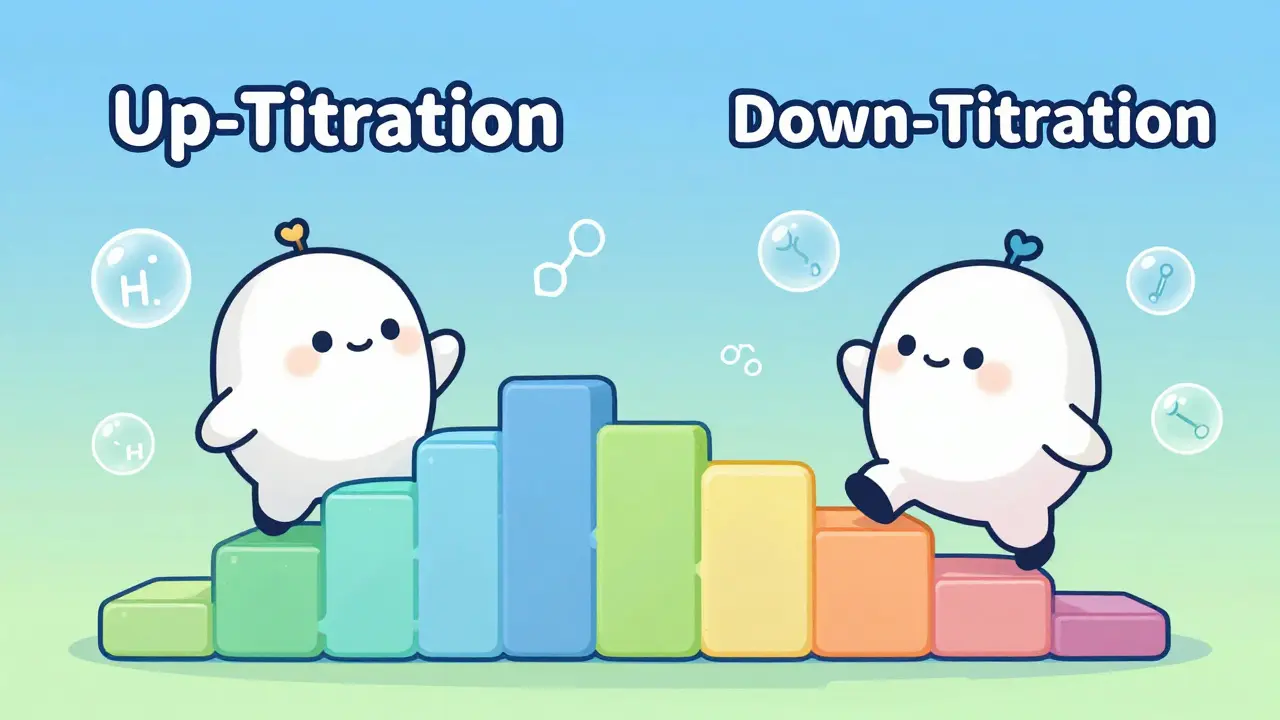
Titration generally moves in two directions. The most common is up-titration, where the dose is gradually increased. For many people, starting at 25-50% of the target dose allows the body to adapt. For instance, with stimulants used for ADHD, doses often increase by 10-25% every few days. This prevents the "shock" to the system that often leads to spikes in blood pressure or insomnia.
Then there is down-titration, or tapering. This is used when a medication needs to be stopped or reduced. Stopping certain drugs abruptly can cause "rebound effects" or withdrawal symptoms. By slowly lowering the dose, you give your brain and organs time to recalibrate to the absence of the chemical.
The timeline varies wildly depending on the drug. Stimulants might reach their optimal dose in 4-6 weeks, while non-stimulants like atomoxetine can take 8-12 weeks because they take longer to build up in your system. If you're using a drug like lamotrigine for epilepsy or mood stability, titration is non-negotiable; increasing the dose too quickly can lead to Stevens-Johnson syndrome, a severe and potentially life-threatening skin reaction.
High-Stakes Dosing: The Narrow Therapeutic Index
Not all drugs require titration, but some absolutely do. The most critical are those with a narrow therapeutic index. This means the window between the dose that cures you and the dose that harms you is very small. Warfarin, a common blood thinner, is a prime example. Because it affects how your blood clots, a tiny miscalculation can lead to internal bleeding or a stroke. This is why patients on warfarin require frequent INR (International Normalized Ratio) testing to tweak their dose constantly.
| Medication Type | Titration Speed | Primary Goal | Monitoring Need |
|---|---|---|---|
| Stimulants (ADHD) | Fast (4-6 weeks) | Manage Anxiety/Sleep | Weekly check-ins |
| Anticoagulants (Warfarin) | Ongoing/Precise | Prevent Bleeding/Clots | Regular blood tests (INR) |
| Anticonvulsants (Lamotrigine) | Slow (5+ weeks) | Prevent Severe Rash | Skin observation |
| Beta-Blockers (Heart Failure) | Gradual | Lower Discontinuation Rates | Blood pressure/Heart rate |
Practical Tips for a Smoother Transition
Titration is a partnership between you and your doctor. Since your physician isn't with you 24/7, you are the primary data collector. A common pitfall is trying to guess how you feel during a follow-up appointment. Human memory is flawed; you might forget that you had a mild headache on Tuesday but remember the nausea on Friday.
To get the most out of your titration, start a side effect journal. Use a simple 1-10 scale to rate symptoms. For example, instead of saying "I felt a bit sick," write "Day 4, Dose 5mg: Nausea level 3/10, peaked 1 hour after ingestion." This concrete data allows your doctor to see patterns and decide if a dose increase is premature.
Additionally, timing is everything. Taking your medication within a 30-60 minute window each day ensures that the levels of the drug in your blood remain steady. Some users have found that taking medication with food significantly reduces stomach-related side effects during the early stages of up-titration, which can make the process much more tolerable.

The Trade-Off: Patience vs. Efficacy
There is a tension in titration: the faster you go, the more side effects you risk; the slower you go, the longer you spend without full symptom relief. In cases of severe depression, some experts warn that overly conservative titration can lead to undertreatment, leaving a patient in a crisis while waiting for a dose that is too low to be effective.
However, for the vast majority of chronic conditions, the patience pays off. Data shows that proper titration can reduce initial side effects by 40-60%. In heart failure patients using beta-blockers, gradual titration has been shown to drop the rate of people quitting their meds due to side effects from 45% down to just 18%. It's a slow burn, but it's the most sustainable way to reach a therapeutic dose.
The Future of Personalized Dosing
We are moving away from the "trial and error" era. New digital tools, such as AI-powered tracking apps, are helping predict the optimal dose based on patient-reported outcomes. Even more exciting is the rise of pharmacogenetic testing. By looking at your DNA, doctors can identify how your liver metabolizes specific enzymes. This means they can tell-before you take the first pill-whether you are a "slow metabolizer" who needs a much lower starting dose or a "rapid metabolizer" who will need a higher dose to see any effect.
While these tools aren't available for every drug yet, the goal is a world where titration is guided by biology rather than just a standard chart. Until then, the gold standard remains a combination of professional guidance, careful logging, and the willingness to move slowly to ensure long-term success.
What is the difference between up-titration and down-titration?
Up-titration is the process of gradually increasing a drug's dose to find the lowest effective amount that treats symptoms without causing adverse effects. Down-titration, often called tapering, is the gradual reduction of a dose to safely stop a medication and avoid withdrawal symptoms or rebound effects.
Why can't I just start at the full dose to get better faster?
Starting at a full dose can overwhelm your body's systems, leading to intense side effects that might cause you to stop the medication entirely. Titration allows your body to build a tolerance and adapt to the chemical changes, significantly increasing the likelihood that you will stick with the treatment long-term.
How long does the titration process usually take?
It depends on the medication. Fast-acting drugs like stimulants may be fully titrated in 4-6 weeks. Slower-acting medications or those with higher risks, such as certain antidepressants or anticonvulsants, can take 8-12 weeks or longer to reach the target dose.
What should I do if I experience a side effect during titration?
First, document the side effect in your log, noting the severity (1-10) and the timing. Contact your healthcare provider immediately. Depending on the severity, your doctor may decide to hold the current dose for another week, reduce the dose, or proceed with caution. Do not adjust your dose independently.
What is a narrow therapeutic index?
A narrow therapeutic index refers to medications where the difference between a therapeutic dose (one that helps) and a toxic dose (one that harms) is very small. These drugs require extremely precise titration and frequent monitoring, such as regular blood tests, to ensure patient safety.