
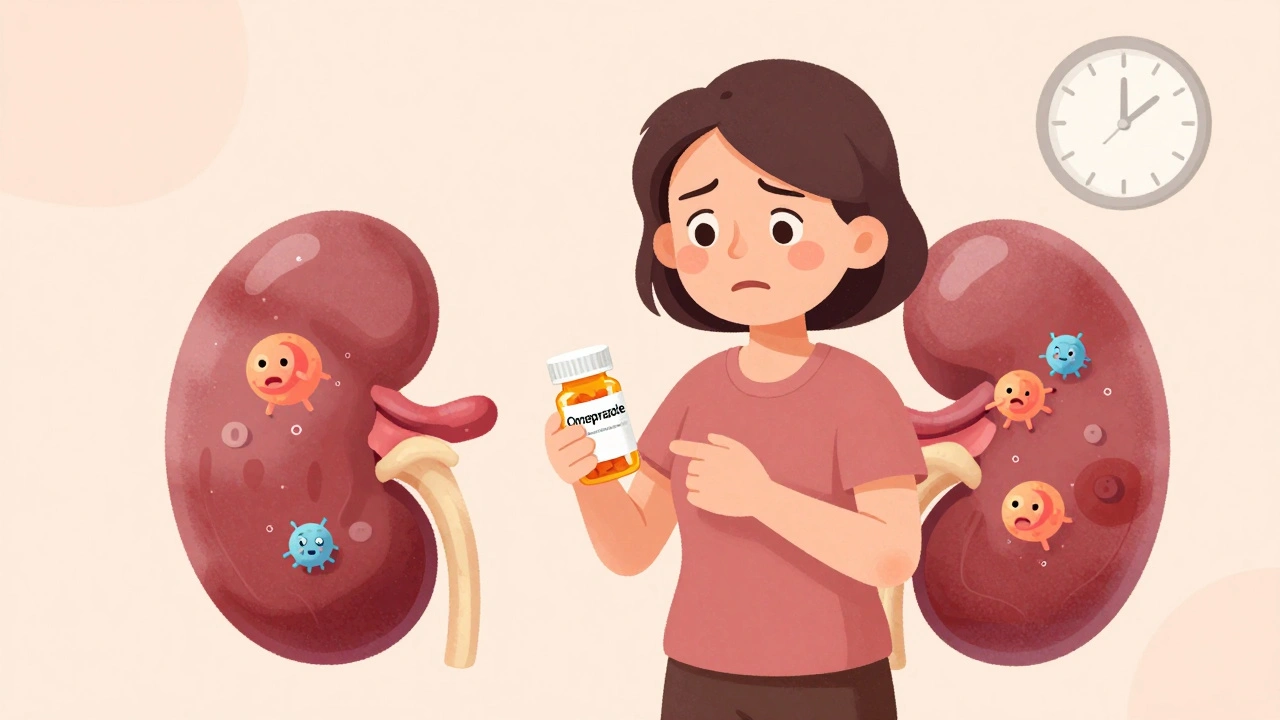
When your kidneys start acting up-swelling, fatigue, little urine output-it’s easy to blame a cold or dehydration. But if you’ve been taking common medications like omeprazole, ibuprofen, or an antibiotic for weeks or months, you could be dealing with something more serious: acute interstitial nephritis. This isn’t a rare glitch. It’s one of the top causes of sudden kidney failure in people over 65, and it’s often missed because the symptoms look like something else entirely.
What Exactly Is Acute Interstitial Nephritis?
Acute interstitial nephritis (AIN) is inflammation in the spaces between the kidney’s filtering tubes. These areas aren’t supposed to get inflamed. But when your immune system reacts to a drug, it sends white blood cells and eosinophils into the kidney tissue like an invasion. The result? Swelling, blocked filters, and a sudden drop in kidney function. It’s not a slow decline. It’s a fast shutdown.
Up to 70% of all AIN cases are caused by medications. That’s not a small number. It’s the leading cause. And the drugs triggering it have changed over time. In the 1990s, it was mostly antibiotics. Today, proton pump inhibitors (PPIs) like omeprazole and pantoprazole are the second most common culprit-right behind NSAIDs like ibuprofen and naproxen.
Which Drugs Are Most Likely to Cause It?
Not all drugs carry the same risk. Here’s what the data shows:
- NSAIDs (44% of drug-induced cases): These are the most common trigger. People on long-term pain relief-often older adults with arthritis or back pain-are at highest risk. Unlike other types, NSAID-induced AIN rarely comes with fever or rash. Instead, it often causes heavy protein loss in urine (sometimes over 3 grams a day), which can mimic kidney disease from diabetes or high blood pressure.
- Antibiotics (33% of cases): Penicillin, amoxicillin, cephalosporins, and even ciprofloxacin can set off AIN. These usually hit faster-within 10 days of starting the drug. You might see a rash, low fever, or eosinophils in your urine. These cases tend to recover better than others.
- Proton Pump Inhibitors (PPIs) (29-38% of cases): Omeprazole, esomeprazole, lansoprazole. These are among the most prescribed drugs in the world. But they’re also quietly damaging kidneys in thousands. PPI-induced AIN often has milder symptoms, which makes it easy to ignore. But here’s the catch: even though the inflammation looks less severe, recovery is worse. Only 50-60% of patients get their kidney function back fully. The rest are left with permanent damage.
- Immune checkpoint inhibitors: These cancer drugs (like pembrolizumab) are newer triggers. They work by turning up the immune system to fight tumors-but sometimes, they turn it against the kidneys too. This form is rare but dangerous.
Even if you’re not on any of these, the risk climbs with every extra pill. If you’re taking five or more medications, your chance of developing AIN is over three times higher than someone on just one or two.
Why Is It So Hard to Diagnose?
AIN doesn’t scream for attention. There’s no single blood test or scan that confirms it. You might feel tired, lose your appetite, have a low fever, or notice your urine output dropping. But those are symptoms of just about everything-flu, UTI, dehydration, even stress.
Doctors often mistake it for a urinary tract infection. In fact, patient forums show that nearly 30% of people with AIN were first told they had a UTI. It takes weeks before anyone considers kidney inflammation. And by then, the damage might already be done.
The only way to be sure? A kidney biopsy. It’s invasive, but it’s the gold standard. Under a microscope, you’ll see immune cells clustered around the kidney tubules, swelling, and sometimes scarring. Other tests-like checking for eosinophils in urine or a gallium scan-are unreliable. They miss too many cases.
As Dr. David Jayne from the University of Cambridge says, "Early recognition is crucial. If you wait, you risk turning a temporary injury into permanent kidney disease."
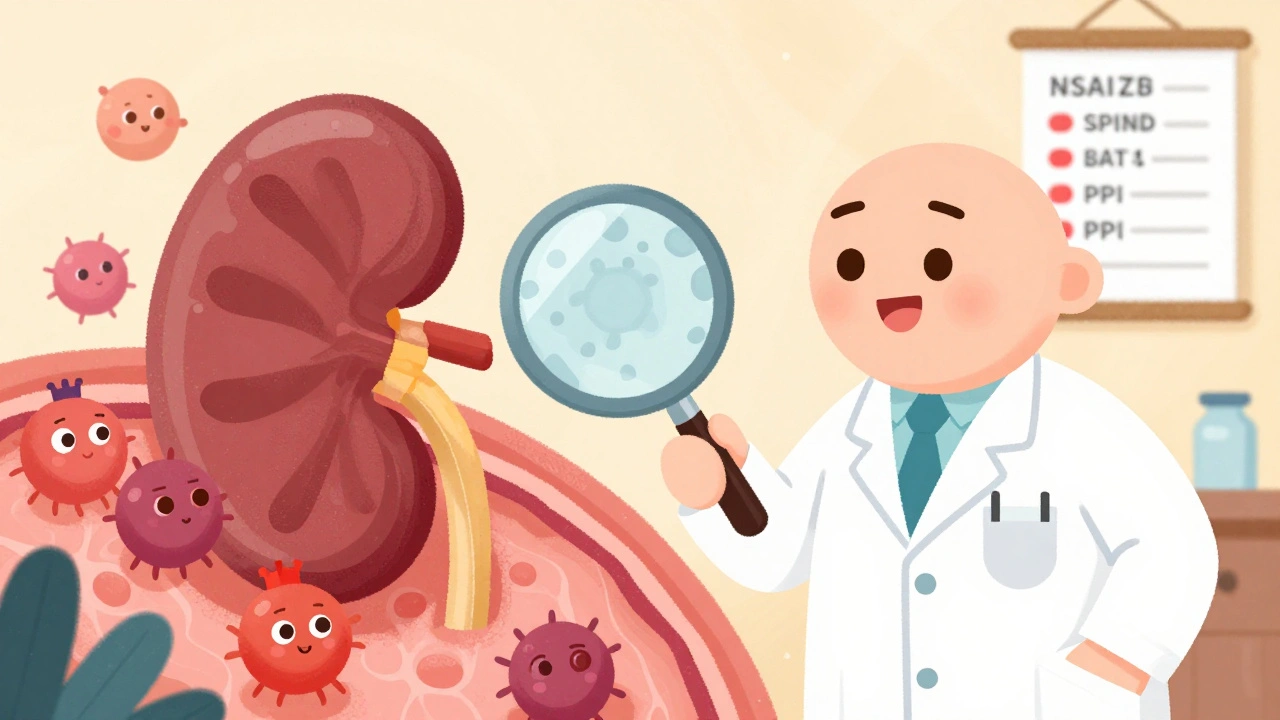
Recovery: What Actually Happens After Stopping the Drug?
The first and most important step? Stop the drug. Immediately. No waiting. No "let’s see how it goes." If you suspect AIN, get off the medication within 24 to 48 hours. That’s the window where recovery chances are highest.
What happens next? It depends on the drug.
- Antibiotic-induced AIN: Most people start feeling better within 72 hours. Kidney function often returns to normal in about 14 days.
- NSAID-induced AIN: Recovery takes longer-around 28 days on average. But even then, only 58% get back to full function. The rest end up with lasting kidney damage.
- PPI-induced AIN: The worst prognosis. Recovery takes 35 days on average. And only half of patients regain normal kidney function. Many are left with eGFR levels below 60 mL/min/1.73m²-meaning they’re now in stage 3 chronic kidney disease.
One real case from the American Kidney Fund tells the story: a 63-year-old woman took omeprazole for 18 months. She developed AIN. She needed dialysis for three weeks. A year later, her kidney function was still at 45 mL/min-40% lower than before.
Do Steroids Help?
This is where things get messy. There are no large, randomized trials proving corticosteroids like prednisone save kidneys in AIN. But in clinical practice, doctors use them anyway-especially when kidney function is already low (eGFR under 30) or if things aren’t improving after 72 hours off the drug.
The typical approach: methylprednisolone (0.5-1 mg/kg/day) for 2-4 weeks, then a slow taper over 6-8 weeks. Some patients respond quickly. Others don’t. But the consensus? If you wait too long to start steroids, they won’t help. Timing matters more than the dose.
As Dr. Ronald J. Falk from UNC Kidney Center notes: "We don’t have perfect proof, but we’ve seen enough patients bounce back with steroids that we can’t ignore them in severe cases."
What Happens If It’s Not Treated?
AIN isn’t always reversible. About 30% of patients develop chronic kidney disease within a year. That means lifelong monitoring, dietary changes, and higher risk of heart disease and stroke.
NSAID-induced AIN has the highest progression rate-42% end up with stage 3 or worse CKD. PPI-induced cases aren’t far behind. Even if you feel fine after stopping the drug, your kidneys might still be scarred.
And here’s the scary part: the number of AIN cases is rising. Between 2010 and 2020, it jumped 27%. Why? Because PPI use exploded. Now, 12 out of every 100,000 people develop PPI-related AIN each year. That’s not rare. That’s epidemic-level.

Who’s Most at Risk?
- People over 65: Risk jumps from 5 per 100,000 in young adults to 22 per 100,000 in seniors.
- Those on multiple medications: Five or more drugs = 3.2x higher risk.
- People with existing kidney issues: Even mild CKD makes you more vulnerable.
- Those taking PPIs long-term: More than 3 months of daily use increases risk significantly.
And it’s not just older people. Younger adults on chronic NSAIDs for migraines or back pain are now showing up in nephrology clinics with AIN. It’s not an "old person’s disease." It’s a medication-overuse disease.
What Should You Do If You’re Worried?
If you’re on any of these drugs and notice:
- Sudden decrease in urine output
- Unexplained fatigue or nausea
- Swelling in ankles or face
- Unexplained fever or rash
-talk to your doctor right away. Don’t wait. Don’t assume it’s a bug. Ask: "Could this be AIN?" Request a serum creatinine test and eGFR calculation. If those are abnormal, push for a nephrology consult.
And if you’ve been on a PPI for more than a year? Ask if you still need it. Most people don’t. The FDA and European regulators now warn against long-term, unnecessary PPI use. There are safer ways to manage heartburn.
The Bottom Line
Acute interstitial nephritis isn’t something you can ignore. It’s a silent side effect of some of the most common drugs in medicine. The good news? If caught early, it’s often fixable. The bad news? Most people don’t know it’s happening until it’s too late.
Your kidneys don’t warn you. They just stop working. And once the scarring sets in, it doesn’t heal.
Stop the drug. Get tested. Don’t wait for the fever or rash. If you’re on a PPI, NSAID, or antibiotic and your kidneys feel off-act now. Your future self will thank you.


Comments(15)