

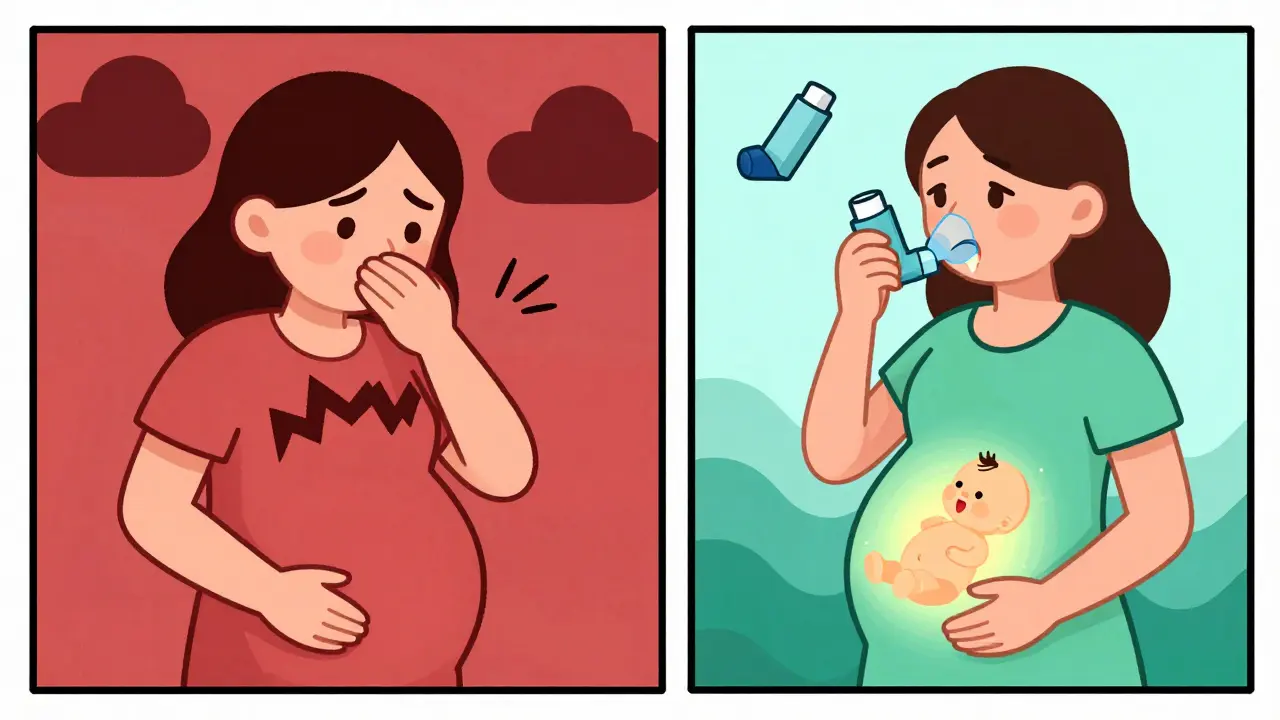
When you’re pregnant and have asthma, the biggest question isn’t just how to control your symptoms-it’s whether the medicine you need is safe for your baby. Many women panic at the thought of using an inhaler during pregnancy, fearing birth defects or long-term harm. But here’s the hard truth: uncontrolled asthma is far more dangerous to your baby than any approved asthma medication.
Studies tracking over 120,000 pregnancies show that women with poorly managed asthma are 5 to 7 times more likely to have complications like preterm birth, low birth weight, or preeclampsia. Meanwhile, the medications most commonly prescribed-like budesonide and albuterol-have been used in thousands of pregnancies with no increase in birth defects. The real risk isn’t the inhaler. It’s the breath you can’t take.
Why Asthma Gets Worse During Pregnancy
Asthma doesn’t just stay the same during pregnancy. For about one-third of women, it gets worse. For another third, it improves. And the rest? It stays about the same. But the pattern isn’t random. The worst time? Between weeks 24 and 36. That’s when hormonal shifts, increased oxygen demand, and pressure from the growing uterus make breathing harder.
If you’re not already on a daily controller medication, this is when flare-ups hit hardest. A cough that won’t quit, wheezing at night, needing your rescue inhaler more than twice a week-these aren’t just inconveniences. They’re signs your lungs aren’t getting enough oxygen. And that oxygen gap? It directly affects your baby’s growth, brain development, and even their ability to stay in the womb until full term.
The Gold Standard: Inhaled Corticosteroids (ICS)
If you had asthma before pregnancy, the best thing you can do is keep taking your daily inhaler. And if you haven’t been on one? Your doctor should start you on one now. The most trusted option? Budesonide.
Why budesonide? Because it’s the most studied. Over 1,000 documented pregnancies show no increased risk of cleft lip, heart defects, or other major birth abnormalities. A 2021 review of 12 studies involving more than 123,000 pregnancies found its adjusted risk of malformations was almost exactly the same as women not taking any asthma medication-1.01 times the risk. That’s not dangerous. That’s normal.
Beclomethasone and fluticasone propionate are also considered safe. But avoid fluticasone furoate and ciclesonide. There’s just not enough data yet. Stick with what’s proven.
Here’s the kicker: ICS don’t just prevent flare-ups. They lower your chance of needing emergency care by 30-50%. That means fewer hospital visits, fewer steroids, fewer risks. And yes, they’re safe for breastfeeding too.
Rescue Inhalers: Albuterol Is Your Friend
Even if you’re on a daily inhaler, you’ll still need a rescue inhaler. That’s normal. Albuterol (also called salbutamol) is the go-to for sudden wheezing or shortness of breath. And yes, it’s safe during pregnancy.
Data from 1.2 million pregnancies show no link between albuterol use and birth defects. It works locally in your lungs. Very little gets into your bloodstream. Even less reaches your baby. And if you’re having a flare-up? Not using it is riskier than using it.
Use it as needed. No shame. No guilt. If you’re struggling to breathe, use your inhaler. Then call your doctor. Don’t wait. Don’t tough it out. Your baby needs you to breathe.
What About Other Medications?
Not all asthma drugs are created equal when you’re pregnant.
- Long-acting beta-agonists (LABA) like formoterol and salmeterol? Only use them if you’re already on an ICS. They’re not meant to be used alone. Studies of over 37,000 pregnancies found no safety issues when used together with ICS.
- Leukotriene modifiers like montelukast (Singulair)? The data is limited but reassuring. A 2022 review of over 1,000 pregnancies found no spike in birth defects. If you were already taking it before pregnancy, you can likely continue.
- Theophylline? It works. But it’s messy. You need blood tests to check levels. It interacts with common antibiotics. Most doctors avoid it unless absolutely necessary.
- Oral corticosteroids (like prednisone)? These are the red flag. A 2023 study of 1.8 million pregnancies showed a 30-60% higher risk of cleft lip/palate if taken in the first trimester. Also linked to preterm birth and low birth weight. Use them only for severe flare-ups, for the shortest time possible, and never as a daily maintenance drug.
- LAMAs like tiotropium? Too little data. Only 324 documented pregnancies. GINA recommends avoiding them during pregnancy.
- Biologics (omalizumab, mepolizumab)? Omalizumab has data from 715 pregnancies with no safety signals. But newer biologics? Almost none. Don’t start them during pregnancy. If you were already on one before conception, talk to your specialist. Don’t stop cold turkey.
What Happens If You Stop Your Medication?
Some women stop their inhalers out of fear. Others are told by well-meaning but misinformed providers to "take a break." That’s a dangerous myth.
A 2021 Canadian registry tracked 1,200 pregnant women with asthma. Of those who stopped their ICS, 41% had at least one severe asthma attack requiring emergency care. Of those who stayed on their medication? Only 17% did. That’s more than double the risk.
And it’s not just about ER visits. Uncontrolled asthma means less oxygen for your baby. That can lead to slower growth, low birth weight, or even stillbirth in rare cases. The medication isn’t the threat. The silence between breaths is.
Monitoring: It’s Not Just About Inhalers
Managing asthma during pregnancy isn’t just about pills and puffs. It’s about tracking.
Use a peak flow meter every day. Your goal? Stay above 80% of your personal best. That’s your baseline. If it drops below 80%, your asthma is worsening. If it falls below 70%, you’re in danger zone-time to call your doctor or go to urgent care.
Keep an asthma diary. Note symptoms, nighttime awakenings, rescue inhaler use. The Asthma Control Test (ACT) is a simple 5-question score. If you score below 20, your asthma isn’t under control. Time to adjust your plan.
And yes, your OB and your pulmonologist should talk. The Society for Maternal-Fetal Medicine recommends joint visits at 8, 16, 24, and 32 weeks. If you’re not getting that, ask for it.
Environmental Triggers: Your Home Matters Too
Medication alone won’t fix asthma if your environment is full of triggers.
- Use allergen-proof mattress and pillow covers. They reduce dust mite exposure by 83%.
- Keep indoor humidity between 30% and 50%. Too high? Mold grows. Too low? Your airways dry out.
- Remove carpets. Hard floors cut allergen load by 55-80%.
- Don’t let pets sleep in your bedroom. Pet dander is a major trigger.
- Avoid smoke-cigarette, wood, or vaping. Secondhand smoke increases asthma attacks by 40%.
These aren’t "nice to have" tips. They’re part of your treatment plan.

What About Newer Treatments and Research?
The science is moving fast. In 2024, the NIH launched a $15.2 million study tracking 2,500 children born to asthmatic mothers to see if asthma meds affect long-term brain development. Early signs? No red flags. But we’re still learning.
And here’s something surprising: 28% of women have a genetic variation (IL-13 gene) that makes them respond better to certain inhaled steroids. Future care might involve testing for this-but it’s not standard yet.
Telemedicine is helping too. In 2023, 47% of pregnant women with asthma used virtual visits for monitoring-up from just 5% before the pandemic. That means more frequent check-ins, fewer hospital trips, better control.
Real Stories, Real Choices
On online forums, 78% of pregnant women with asthma say they’re terrified of their inhaler. They’ve heard horror stories. They’ve been told to "just breathe through it." But here’s what the women who kept their medication say: "I thought I was being reckless. Turns out, I was being smart. My daughter was born at 39 weeks, 7 pounds, 12 ounces. No NICU. No oxygen. Just healthy."
Another wrote: "I stopped my inhaler because my OB said it was risky. I ended up in the ER at 31 weeks. They gave me steroids. My baby was tiny. I regret that decision every day." The choice isn’t between medication and safety. It’s between control and crisis.
Final Takeaway: Don’t Risk Your Breath
If you’re pregnant and have asthma, your job isn’t to avoid medicine. It’s to stay in control. Use your daily inhaler. Keep your rescue inhaler handy. Track your breathing. Avoid triggers. Get regular check-ups.
The data is clear: the safest thing you can do for your baby is to breathe well yourself. Medications like budesonide and albuterol aren’t risky-they’re lifesaving. And if your doctor isn’t telling you that? Ask for a second opinion. Your lungs-and your baby’s future-depend on it.




Comments(15)