
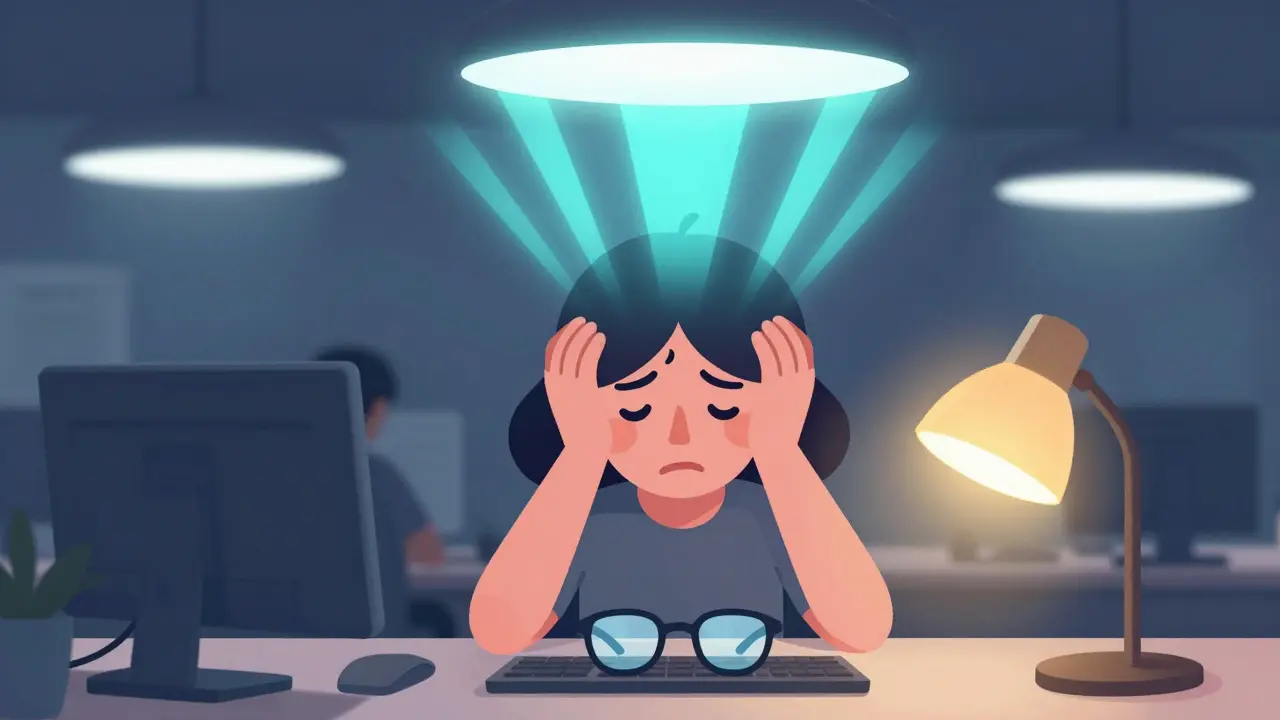
Light hurts your eyes. Not just when you step outside on a sunny day, but even under office fluorescent lights, or worse-when you’re just trying to scroll on your phone at night. If this sounds familiar, you’re not alone. About 35% of people experience some level of photophobia, or abnormal sensitivity to light. But here’s the thing: photophobia isn’t a condition on its own. It’s your body’s warning signal. Something deeper is going on, and ignoring it can delay treatment for serious issues like uveitis, migraines, or even autoimmune disorders.
What Exactly Is Photophobia?
Photophobia doesn’t mean you’re afraid of light. That’s a common misunderstanding. The word sounds like a phobia, but it’s actually a symptom. Your eyes and brain are overreacting to light that most people find perfectly normal. People with normal vision can handle 5-10 lux of light without discomfort. But someone with photophobia might feel pain at just 0.5-2.0 lux. That’s the brightness of a dim hallway at night.The American Academy of Ophthalmology breaks down causes into three main buckets:
- Eye-related issues (45% of cases): Think corneal abrasions, uveitis, albinism, or even dry eye syndrome. In uveitis, 92% of patients report light sensitivity before any other symptoms show up.
- Neurological conditions (40% of cases): Migraines are the biggest culprit here. Up to 80% of migraine sufferers experience photophobia during an attack. It’s not just a side effect-it’s part of how the migraine process works in the brain.
- Medication-induced (15% of cases): Some antibiotics, antihistamines, and even certain acne medications can make your eyes more sensitive to light.
Women between 25 and 55 are most affected, making up 65% of cases. And while it’s often dismissed as “just being sensitive,” untreated photophobia can reduce workplace productivity by over 50%. It’s not just annoying-it’s disabling.
How Bad Is Your Light Sensitivity?
Not all photophobia is the same. It comes in three levels:- Mild (48%): Only bothers you in direct sunlight. You might squint or look away, but indoor lighting is fine.
- Moderate (37%): You need sunglasses even inside under fluorescent or LED lights. Office work becomes a challenge.
- Severe (15%): Painful in normal indoor lighting (around 50 lux). Even dim rooms feel too bright. Some people describe it as a stabbing sensation behind the eyes.
Doctors use a tool called the Photophobia Severity Scale (PSS-10) to measure impact. A score above 25 means your daily life is seriously affected. In severe cases, visual acuity drops to 20/40 or worse in bright conditions. That’s the difference between reading a menu clearly and struggling to make out the words.
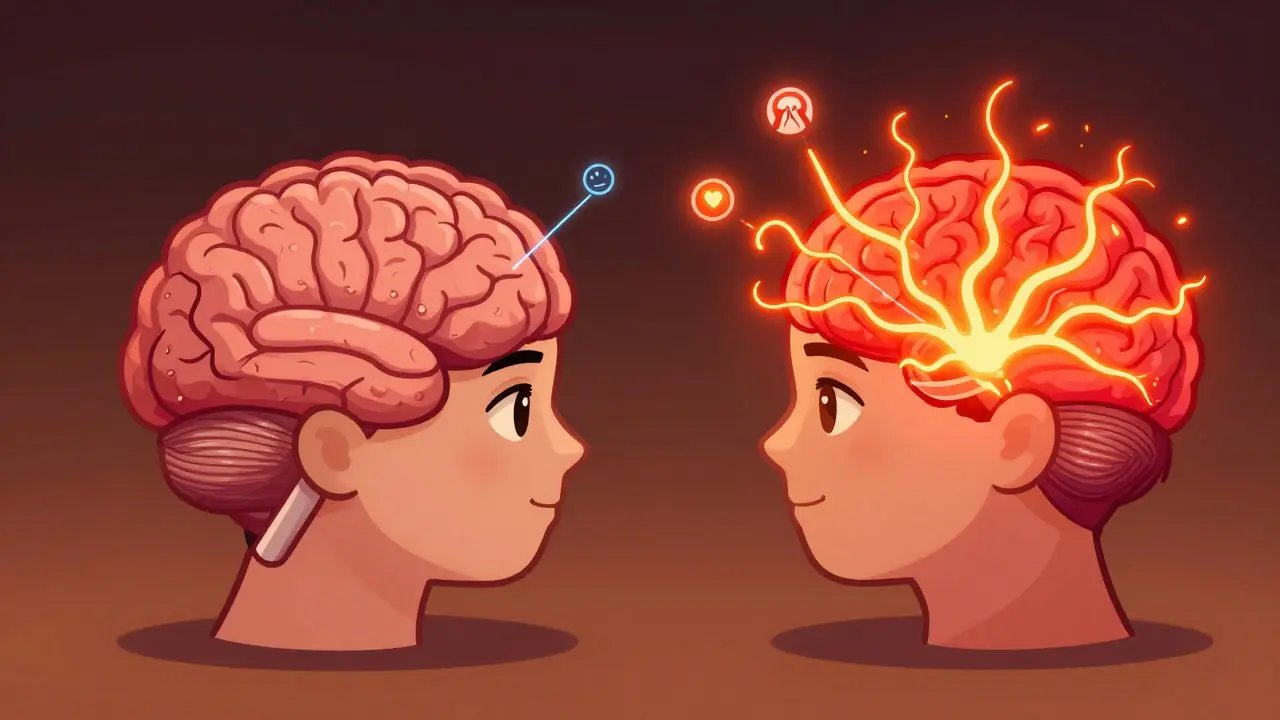
What makes photophobia different from normal light sensitivity is how your brain responds. fMRI scans show photophobic individuals have 3.2 times more neural activity in the thalamus-the brain’s light-processing center-when exposed to standard office lighting. It’s not your eyes failing. It’s your nervous system on overdrive.
The Real Culprits Behind Your Light Sensitivity
If you’ve been told “it’s just migraines,” you might be missing something bigger. Migraines are common, but they’re not the only cause. Here’s what else could be going on:- Uveitis: Inflammation inside the eye. Often mistaken for a persistent migraine. Left untreated, it can cause permanent vision loss.
- Autoimmune diseases: Lupus, Sjögren’s syndrome, and rheumatoid arthritis can trigger photophobia. In fact, 46% of non-eye-related photophobia cases link back to autoimmune disorders.
- Concussion or brain injury: Trauma to the head can disrupt how the brain processes light, leading to long-term sensitivity.
- Albinism: Lack of pigment in the iris means more light enters the eye, causing glare and discomfort.
- Medications: Tetracycline, doxycycline, and certain diuretics can increase light sensitivity as a side effect.
Dr. Rania Habib from Mount Sinai says photophobia is a red flag in 12% of emergency cases-often showing up 48 to 72 hours before a formal diagnosis of meningitis or other neurological emergencies. If your light sensitivity came on suddenly and is accompanied by headache, fever, or neck stiffness, get checked immediately.
Solutions That Actually Work
There’s no FDA-approved drug to cure photophobia itself. But there are proven ways to manage it-by targeting the root cause and reducing daily triggers.1. FL-41 Tinted Lenses
This isn’t just another pair of sunglasses. FL-41 lenses are specially tinted to block the exact wavelengths of light that trigger discomfort: blue-green light between 500-550 nanometers. Studies show they reduce symptoms by 43%. In one trial, users saw their migraine frequency drop from 18 to 5 per month within three weeks.Brands like TheraSpecs dominate the market with 63% share, priced around $149 per pair. But not all “blue-light blocking” glasses work. Many target 450nm (used for screen glare), but photophobia needs filtering at 500-550nm. Using the wrong lenses can make things worse.
Most people need 2-3 weeks to adapt. Initial color distortion is normal-everything looks slightly pinkish. But after a few days, your brain adjusts, and the relief kicks in.
2. Environmental Adjustments
Workplace lighting is a major trigger. The average office runs at 500 lux. For someone with photophobia, that’s too bright. The solution? Reduce ambient light to 100-200 lux.- Swap fluorescent bulbs for warm-white LEDs (2700K-3000K color temperature).
- Use desk lamps instead of overhead lights.
- Install smart lighting like Philips Hue to dim or change color tones remotely.
Even better-28% of Fortune 500 companies now have “migraine-friendly” lighting policies. They’ve seen sick days drop by 17%. OSHA’s new lighting standards (effective January 2024) require adjustable lighting between 300-500 lux in workplaces. You have a right to a comfortable environment.
3. Medical Treatment
If your photophobia is tied to migraines, newer medications called CGRP inhibitors (like Aimovig or Emgality) can help. These monthly injections reduce migraine frequency by up to 50% and often cut photophobia along with it. Cost? Around $690 per month-but many insurance plans cover it if you have a documented diagnosis.For eye-related causes like uveitis, steroid eye drops or immunosuppressants are the go-to. Early treatment prevents permanent damage.
What Doesn’t Work (And Why)
There’s a lot of misinformation out there.- Blue-light blocking glasses for screens: These target 450nm, but photophobia is triggered by 500-550nm. They’re useless for this.
- Wearing sunglasses indoors all the time: This makes your eyes even more sensitive over time. It’s like avoiding sunlight to treat vitamin D deficiency-it backfires.
- Ignoring symptoms: 82% of patients in one survey were initially misdiagnosed with “just migraines” when they actually had uveitis or lupus. Delayed diagnosis = higher risk of permanent damage.
Dr. Sarah Lee from the National Eye Institute says digital screen filters only fix 38% of triggers. The real problem? Ambient lighting. Fix the room, not just the device.

What to Do Next
If you’re dealing with light sensitivity, here’s your step-by-step plan:- Track your symptoms. Use the Photophobia Impact Assessment scale. Note when it happens, how bright the light was, and what you were doing.
- Get a full eye exam. Rule out corneal issues, uveitis, glaucoma, or cataracts. Ask for a dilated exam.
- See a neurologist if your eyes are clear. Migraines, concussions, or other neurological causes need evaluation.
- Try FL-41 lenses. Get them from a professional optometrist who understands photophobia. Don’t buy random ones online.
- Adjust your environment. Dim lights, use warm tones, avoid fluorescents.
- Consider medication if migraines are the cause. Talk to your doctor about CGRP inhibitors.
Most people see improvement within 6 months with proper management. Autoimmune cases may need lifelong care, but quality of life can still improve dramatically.
When to Worry
Photophobia is usually manageable. But some signs mean you need emergency care:- Sudden onset of severe light sensitivity
- Along with headache, fever, vomiting, or stiff neck
- Loss of vision or seeing halos around lights
- Eye redness or pain that won’t go away
These could signal meningitis, encephalitis, or a retinal detachment. Don’t wait. Go to the ER.
Resources That Help
- American Migraine Foundation: Offers a 24/7 helpline and patient support tools.
- National Eye Institute: Free online symptom tracker used by over 42,000 people monthly.
- TheraSpecs: Offers a 30-day trial with free returns if the lenses don’t help.
Photophobia isn’t something you just have to live with. It’s a signal-and once you understand what it’s telling you, you can take back control.
Is photophobia the same as being sensitive to bright light?
No. Everyone feels discomfort in bright sunlight-that’s normal. Photophobia is an abnormal, painful reaction to light levels that most people find comfortable, like indoor lighting or computer screens. It’s not just brightness-it’s the brain’s overreaction to specific wavelengths of light.
Can FL-41 lenses cure photophobia?
No, they don’t cure it. But they’re one of the most effective tools for managing symptoms. FL-41 lenses block the exact blue-green light wavelengths that trigger pain in photophobic individuals. Studies show they reduce symptoms by 43% and can cut migraine frequency by up to 70% when used consistently.
Why do my eyes hurt under LED lights?
Many LED lights emit a spike in the 500-550nm wavelength range-the same light that triggers photophobia. Even if they look “white,” they’re often too harsh for sensitive eyes. Warm-white LEDs (2700K-3000K) are better, but FL-41 lenses are still the most reliable solution for indoor lighting.
Can photophobia lead to permanent vision loss?
Photophobia itself doesn’t cause vision loss. But the conditions behind it can. Uveitis, if untreated, can scar the iris or damage the retina. Meningitis can affect the optic nerve. That’s why photophobia is a warning sign-it’s your body saying, “Look deeper.”
Is photophobia more common in women?
Yes. Around 65% of photophobia cases occur in women, especially between ages 25 and 55. This is likely linked to higher rates of migraines and autoimmune conditions like lupus and Sjögren’s syndrome, which are more common in women.
Should I wear sunglasses all the time indoors?
No. Wearing sunglasses indoors can make your eyes more sensitive over time by reducing your exposure to normal light levels. Instead, use FL-41 lenses designed for indoor use, or adjust your lighting. Your eyes need light to stay healthy-it’s the wrong kind of light that’s the problem.
Can digital screens cause photophobia?
Screens don’t cause photophobia, but they can worsen it. The real issue is ambient lighting. If your room is too bright or too dim compared to your screen, your eyes strain. Fix the lighting around you first. Blue-light filters on screens only help 38% of the time.
Are there any new treatments on the horizon?
Yes. The FDA approved the Photosensitivity Assessment Device (PAD-2000) in May 2023 to accurately diagnose photophobia. Research is also underway for a topical eye drop targeting TRPM8 receptors-expected to reduce light sensitivity by 60% in trials. Results should be available by 2025.






Comments(14)