

Getting the right dose of medicine for your child isn’t just important-it can be life-saving. Too little and the infection won’t clear. Too much, and you could be putting your child in serious danger. In fact, 7 in 10 parents make at least one mistake when measuring liquid medicine at home. Most of these errors happen because people use kitchen spoons, misread labels, or don’t know the difference between mg and mL. The good news? With the right tools and a few simple steps, you can avoid these mistakes entirely.
Why Milliliters (mL) Are the Only Unit That Matters
For decades, doctors wrote prescriptions in teaspoons and tablespoons. But those aren’t precise. A kitchen teaspoon can hold anywhere from 3.9 to 7.3 milliliters-way off from the standard 5 mL. That’s why the CDC, the American Academy of Pediatrics, and the FDA now agree: all pediatric liquid medications must be measured in milliliters (mL). No more teaspoons. No more tablespoons.
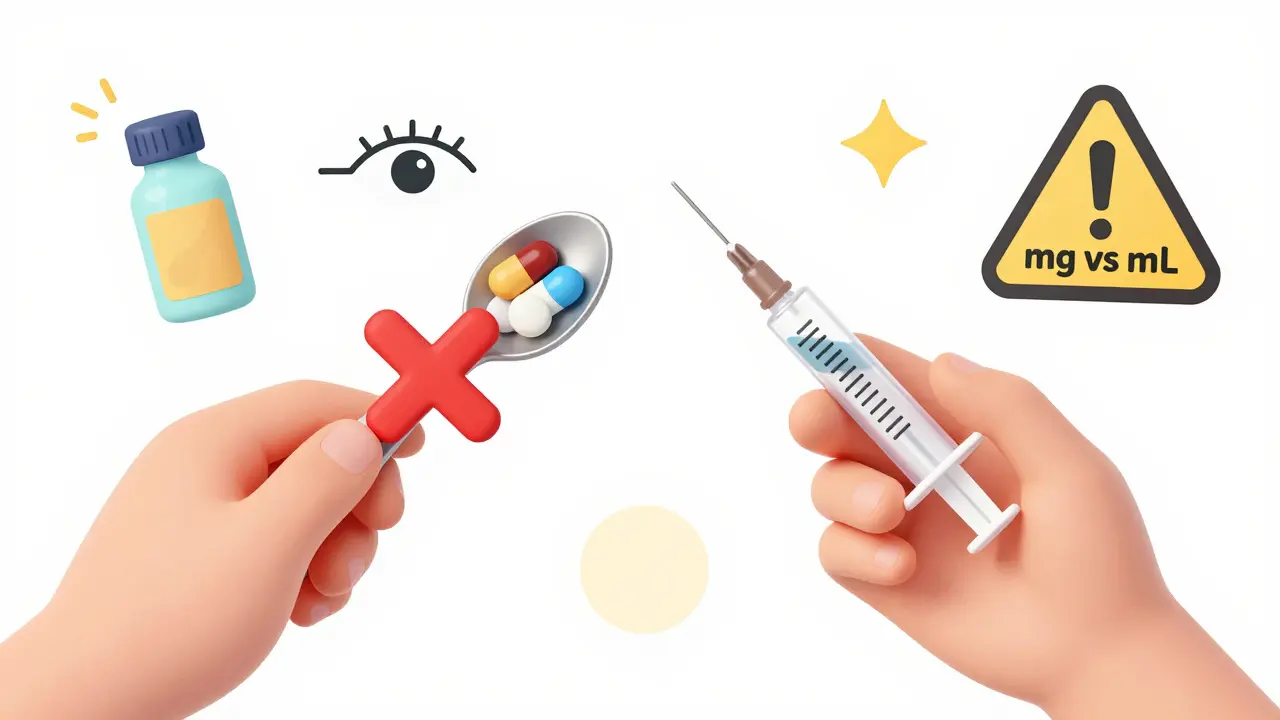
Confusing mg (milligrams, the amount of drug) with mL (the volume of liquid) is one of the most dangerous mistakes. A child’s dose might be 10 mg per mL, but if you think it’s 10 mL per dose, you’re giving ten times the medicine. That’s not a typo-it’s a hospital visit. The CDC’s PROTECT initiative was created to stop this exact kind of error. Since 2010, they’ve pushed for mL-only labeling on all children’s medicine bottles. Today, 78% of pediatric liquid medications follow this rule, up from just 42% in 2015.
The Best Tools for Measuring Liquid Medicine
Not all measuring tools are created equal. Here’s what works-and what doesn’t.
- Oral syringes (1-10 mL): These are the gold standard, especially for doses under 5 mL. They’re accurate to within 1-2%, and you can see exactly how much medicine you’re giving. Studies show they reduce dosing errors by 42% compared to cups.
- Dosing cups (5-30 mL): These are okay for older kids who can drink directly from the cup, but they’re risky for small doses. At 2.5 mL, error rates jump to nearly 70%. If you use one, always check the line at eye level.
- Droppers (1-2 mL): Good for babies or tiny doses, but easy to spill. Hold it vertical and squeeze slowly.
- Medication spoons: Only use ones labeled with mL. A regular household spoon? Never. They vary too much.
For doses under 5 mL-like antibiotics or fever reducers-always use an oral syringe. For older kids who refuse the syringe, a dosing cup can work if you’re careful. But never, ever use a kitchen spoon.
How to Use an Oral Syringe Correctly
Even the best tool won’t help if you don’t use it right. Here’s how to do it step by step:
- Shake the bottle well before drawing up the medicine. Some suspensions settle at the bottom-if you don’t shake, you might give half the dose.
- Remove the cap and insert the syringe tip into the bottle.
- Turn the bottle upside down and slowly pull the plunger until the top of the liquid lines up with your child’s dose (e.g., 4.5 mL).
- Hold the syringe upright and check the level again. Look at the meniscus-the curved surface of the liquid-at eye level. Don’t look from above or below.
- Give the medicine slowly into the side of your child’s mouth, near the cheek. This avoids triggering the tongue-thrust reflex that makes kids spit it out.
- After use, rinse the syringe with water and let it air dry. Don’t store it with the plunger pushed in.
Pro tip: If your child gets the same dose every day, mark the syringe with a permanent marker. For example, draw a line at 2.5 mL for amoxicillin. That way, you don’t have to read the numbers every time.
Weight-Based Dosing: How to Calculate the Right Amount
Many children’s medicines are dosed by weight: milligrams per kilogram (mg/kg). That means you need to know your child’s exact weight in kilograms, not pounds.
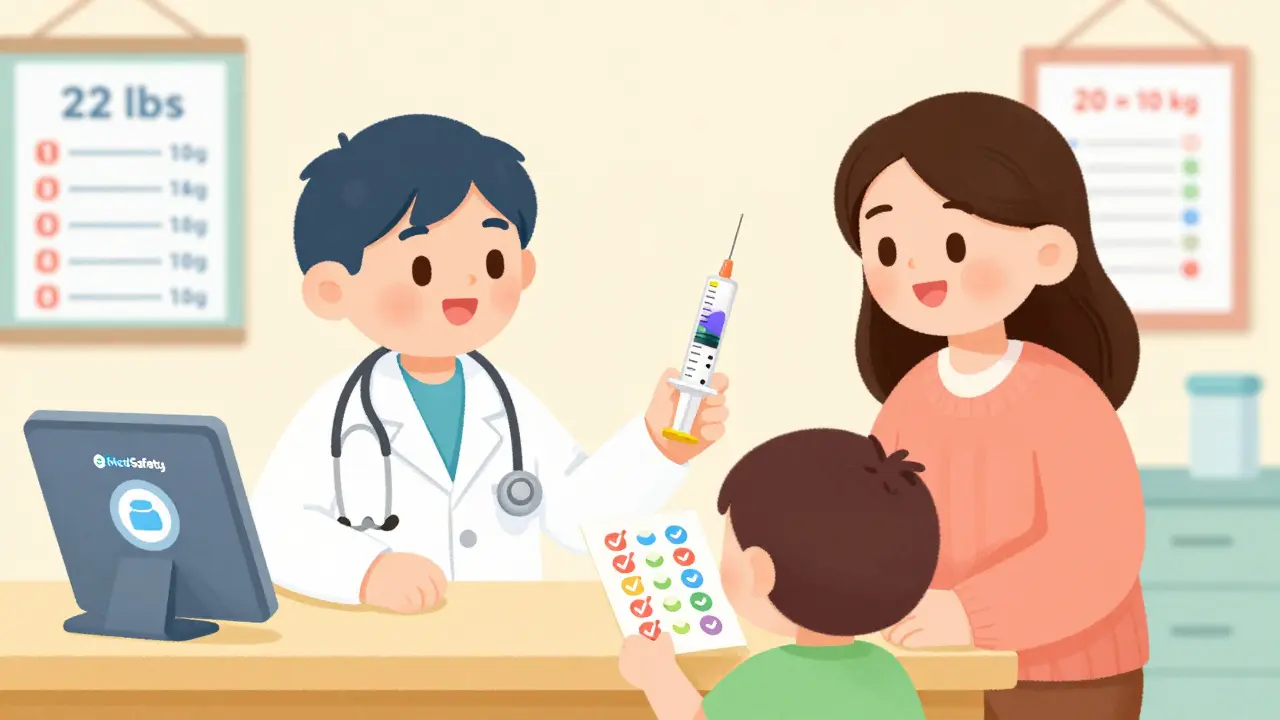
Here’s the conversion: 1 kg = 2.2 lb. So if your child weighs 22 pounds, divide by 2.2: 22 ÷ 2.2 = 10 kg.
Now check the label. Say the medicine is 40 mg/kg/day, split into two doses. That’s 40 × 10 = 400 mg total per day. Divide by two: 200 mg per dose.
If the concentration is 400 mg per 5 mL, then 200 mg is half of that: 2.5 mL per dose.
Always double-check with your pharmacist or doctor if you’re unsure. Don’t guess. A small math error can lead to a big problem.
Common Mistakes Parents Make (And How to Avoid Them)
Here are the most frequent errors-and how to fix them:
- Mistake: Using a kitchen spoon. Fix: Keep a dedicated oral syringe with each medicine. Store it in the fridge with the bottle.
- Mistake: Not shaking the bottle. Fix: Shake for 10 seconds every time before measuring. Some suspensions settle fast.
- Mistake: Giving medicine in the front of the mouth. Fix: Aim for the cheek pouch. It’s harder for kids to spit out.
- Mistake: Assuming a full dose because the bottle says ‘1 tsp’. Fix: Ignore tsp on labels. Only trust mL. If it says ‘1 tsp’, convert it: 1 tsp = 5 mL.
- Mistake: Using two different syringes for the same medicine. Fix: Use the one that came with the bottle. Don’t swap tools between meds.
One parent on Reddit shared how their child nearly overdosed after using a tablespoon instead of a syringe. The medicine was 5 mL per dose, but they used a kitchen tablespoon (15 mL). That’s three times too much. The child ended up in the ER with vomiting and drowsiness. It took 12 hours to recover.
What to Do If You’re Not Sure
If you’re confused about the dose, don’t guess. Call your pharmacist or pediatrician. They’re used to these questions. You’re not being a bother-you’re being smart.
Many hospitals now give out free oral syringes at discharge. If yours didn’t, ask for one. Some pharmacies offer them for under $5. Look for brands like NurtureShot or Medisana BabyDos-they’re color-coded and labeled in mL only.
There are also apps like MedSafety that use your phone’s camera to show you how to measure the right amount. In trials, they reduced errors by over half. Download one if your child takes medicine regularly.
Special Cases: Antibiotics, Fever Reducers, and High-Risk Medicines
Some medicines need extra care.
- Antibiotics like amoxicillin: Always shake well. Under-dosing leads to resistant bacteria. Use a syringe, not a cup.
- Acetaminophen or ibuprofen: These are common, but easy to overdo. Never give both at the same time unless a doctor says so. Check the concentration-some are 160 mg/5 mL, others are 80 mg/5 mL. Mixing them up can cause liver damage.
- High-risk medicines like digoxin, seizure meds, or chemotherapy: These have a narrow safety window. Even a 0.5 mL mistake can be dangerous. Always use an oral syringe. Double-check with two adults if possible.
Keep a written dosing chart for your child. Write down their weight, each medicine, the dose in mL, how often, and the time. Tape it to the fridge. Update it when they gain weight or get a new prescription.
When to Get Help
If you think you gave the wrong dose, call Poison Control immediately. In Australia, that’s 13 11 26. Don’t wait for symptoms. Even if your child seems fine, it’s better to be safe.
Also, if you’re struggling with language barriers, ask for translated instructions. Pharmacies in Sydney and other major cities often have multilingual staff or printed materials in Mandarin, Arabic, Vietnamese, and other languages. You’re not alone-41% of non-English-speaking parents report confusion over dosing.
Final Reminder: Accuracy Saves Lives
Measuring children’s medicine correctly isn’t about being perfect. It’s about being consistent. Use the right tool. Read the label in mL. Shake the bottle. Measure at eye level. When in doubt, call someone.
Every year, thousands of children are rushed to hospitals because of simple dosing mistakes. Most of them are preventable. You have the power to keep your child safe-not with expensive gadgets, but with simple, smart habits.
Can I use a kitchen teaspoon to measure my child’s medicine?
No. A kitchen teaspoon varies in size from 3.9 to 7.3 milliliters, while the standard dose is exactly 5 mL. Using it can lead to under-dosing or overdosing by up to 50%. Always use an oral syringe or dosing cup marked in milliliters (mL).
What’s the difference between mg and mL?
Milligrams (mg) measure the amount of active drug in the medicine. Milliliters (mL) measure the volume of liquid. A medicine might be 10 mg per mL, meaning each mL contains 10 mg of the drug. Confusing the two can lead to a tenfold overdose, which can be deadly.
Should I use a dosing cup or an oral syringe?
For doses under 5 mL, always use an oral syringe-they’re 42% more accurate. For older children who can drink from a cup and need 5 mL or more, a dosing cup is acceptable. But never use it for small doses-it’s too easy to misread.
How do I convert my child’s weight from pounds to kilograms?
Divide the weight in pounds by 2.2. For example, a child weighing 22 pounds is 10 kg (22 ÷ 2.2 = 10). This is needed to calculate correct doses like 10 mg/kg.
What should I do if I give the wrong dose?
Call Poison Control immediately at 13 11 26 (Australia). Do not wait for symptoms. Even if your child seems fine, an overdose can take hours to show effects. Keep the medicine bottle handy when you call.
Can I mix medicine with juice or food to make it easier for my child to take?
Yes, but only if your doctor or pharmacist says it’s safe. Some medicines lose effectiveness if mixed. For safe options, mix the full dose with a small amount of apple sauce, yogurt, or chocolate syrup. Make sure your child eats the whole portion-don’t leave any behind.





Comments(12)