
Every year, thousands of patients in the U.S. and around the world face delays or outright shortages of life-saving medications. It’s not just about running out of a prescription-it’s about not having access to antibiotics when you need them, or sterile injectables during emergency surgery, or insulin during a diabetic crisis. These aren’t rare glitches. In 2022 alone, the FDA recorded 245 drug shortages, with over half involving injectable medicines used in hospitals. The cost? Over $216 million in extra healthcare spending. And it’s not getting better. The system we rely on was built for efficiency, not endurance. Now, we’re learning how to build resilience into the drug supply-not as a reaction, but as a foundation.
Why the drug supply is so fragile
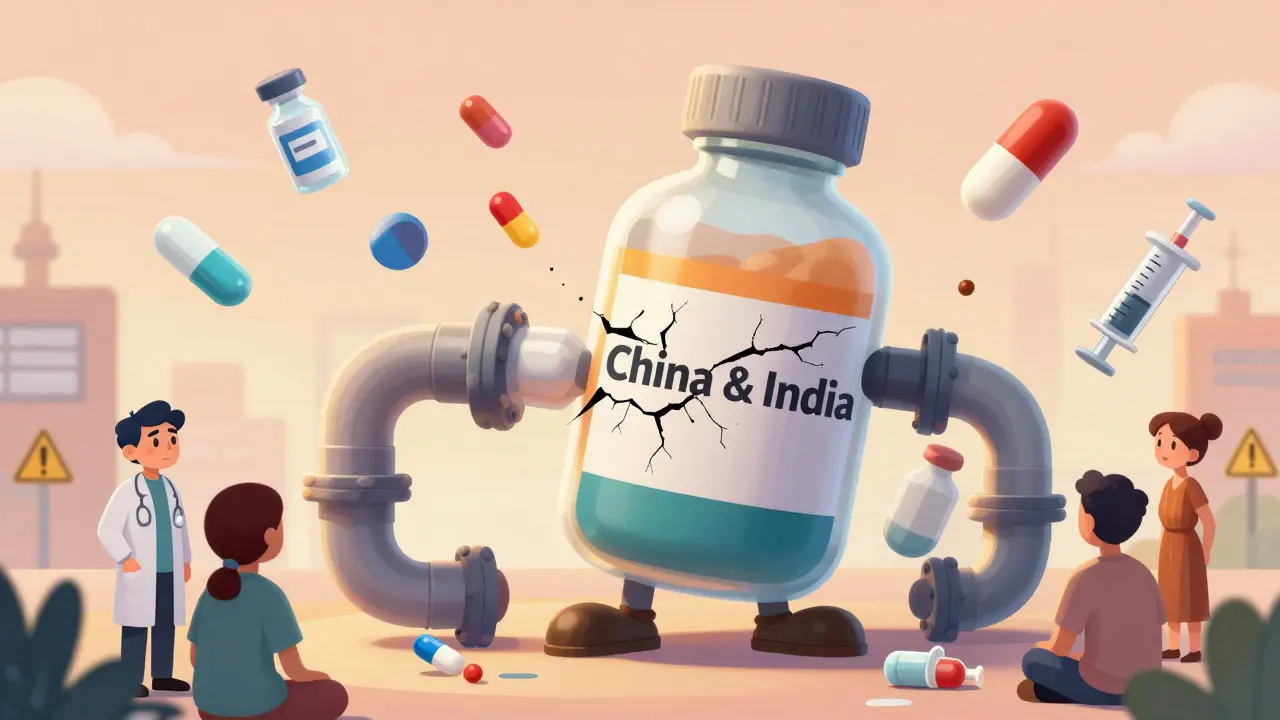
The modern pharmaceutical supply chain is a global machine designed to cut costs, not avoid risk. Most active pharmaceutical ingredients (APIs)-the core chemical components of drugs-are made in just two countries: China and India. Together, they produce nearly 30% of all APIs used in the U.S. That’s not diversity. That’s concentration. One factory shutdown, one natural disaster, one trade restriction, and entire drug lines vanish overnight. The 2020 pandemic showed this in real time. When factories in India slowed production due to lockdowns, U.S. hospitals scrambled for alternatives. Some didn’t find any.Even worse, most companies only track their immediate suppliers. Only 12% know where the raw materials for their drugs come from. That’s like building a house without knowing where the bricks were mined. If a mine in Brazil shuts down or a shipping lane gets blocked, no one sees it coming until the shelves are empty. And cybersecurity? It’s been ignored. Between 2020 and 2023, cyberattacks on healthcare supply chains jumped 214%. A single ransomware attack can freeze production for weeks. The system wasn’t designed to handle shocks. It was designed to run quietly-until it didn’t.
What resilience actually looks like
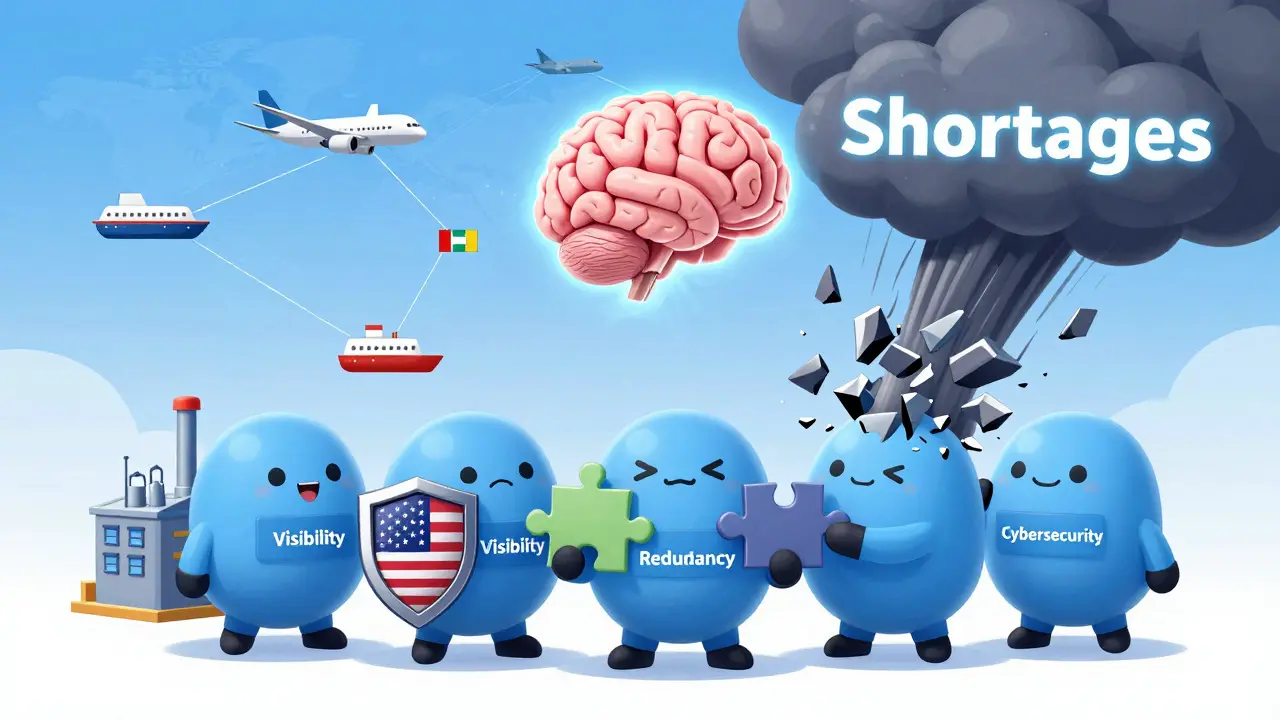
Building resilience doesn’t mean going back to the 1980s. It means rethinking how drugs move from lab to patient. The National Academies of Sciences laid out a clear framework: anticipate, plan, manage risk. Simple words. Hard to execute.First, anticipation. You can’t fix what you don’t see. Companies need full supply chain mapping-down to Tier 3 suppliers. That means knowing where your raw materials come from, who mines them, and who transports them. Only 8% of companies have this level of visibility. Those that do report 32% fewer disruptions. Tools powered by AI can now predict supply disruptions with 83% accuracy 30 days out. That’s not science fiction. It’s happening now.
Second, strategic planning. This is where the real change happens. Instead of relying on one supplier, companies should have at least three-spread across different continents. For critical drugs, manufacturers should dual-source APIs so that 80% of usage can be covered by two independent production lines. And they need to build in substitution capacity: at least 15% of formularies should include pre-approved alternative versions of key drugs. That way, if one version runs out, another can step in without delay.
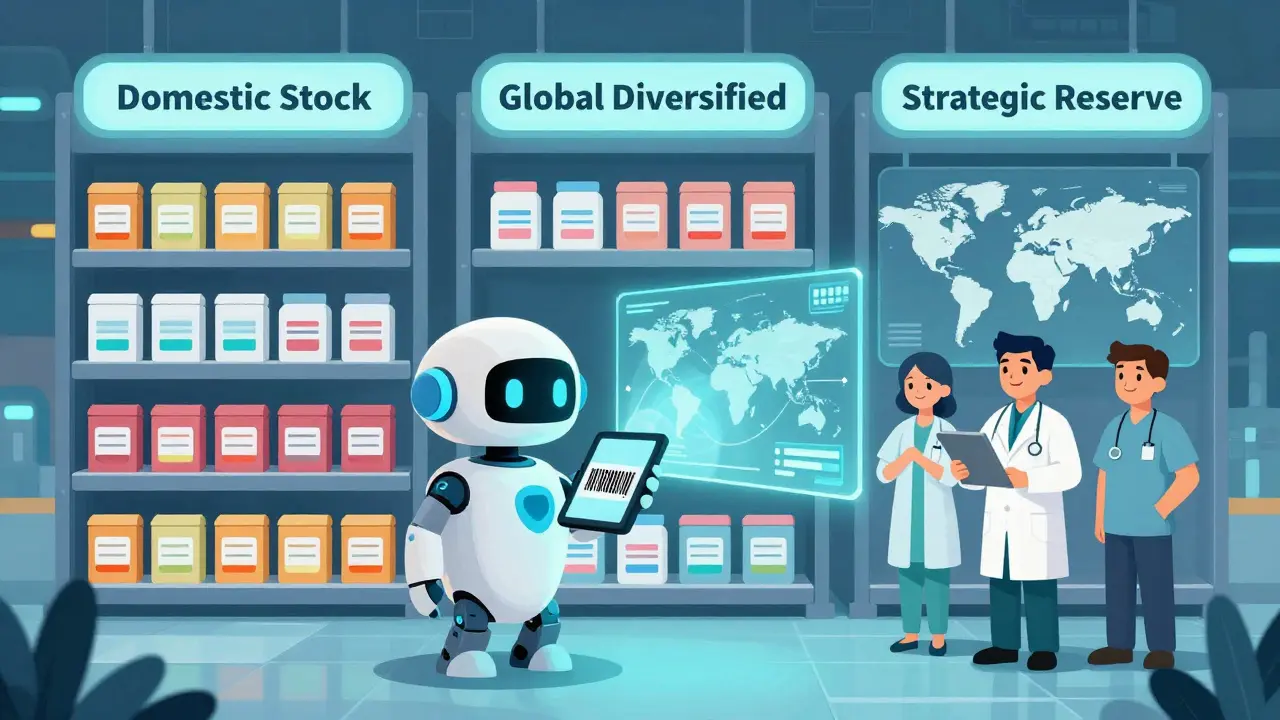
Third, risk mitigation. Buffer stocks. Not just a few weeks’ supply. The experts say 6 to 12 months for essential medicines. That sounds expensive. But it’s cheaper than a hospital scrambling for last-minute alternatives. The math is clear: stockpiling alone costs $3.5-4.2 billion a year. But it only prevents 45% of shortages. The smarter move? A hybrid model: keep strategic reserves for the most critical drugs, while diversifying suppliers for the rest. That approach can prevent 85% of shortages at a cost of just $1.2-1.8 billion annually.
Domestic manufacturing vs. global diversification
One idea that keeps coming up is bringing drug production back home. Reshoring API manufacturing sounds appealing. But it’s not cheap. L.E.K. Consulting found it adds 25-40% to production costs. That’s why Pfizer and Merck didn’t do it for everything. They picked their battles. Merck used $85 million in federal funding to shift 12 critical antibiotics to U.S. production. It worked. But their costs went up 31%. That forced Medicare to adjust reimbursement rates just to keep the drugs affordable.So is reshoring the answer? Not alone. The real win comes from combining domestic capacity for the most vital drugs-with global diversification for the rest. Think of it like a fire department: you need local stations for quick response, but you also need regional hubs for backup. The Duke-Margolis Center estimates this hybrid model prevents 85% of shortages while staying within a realistic budget. It’s not about going all-in on one strategy. It’s about layering them.
The role of technology and data
Resilience isn’t just about factories and stockpiles. It’s about data. Right now, 78% of pharmaceutical companies use incompatible systems across their supply chain partners. A shipment from a supplier in Germany can’t talk to the inventory system in Ohio. That’s chaos. AI and blockchain are starting to fix this. AI-driven forecasting tools now help companies anticipate demand spikes before they happen. Blockchain-based tracking lets every party in the chain see where a drug is, who handled it, and if anything went wrong. Pfizer’s AI system cut stockouts by 38% after a $220 million investment. It wasn’t magic. It was data.Cybersecurity is no longer optional. The Healthcare Distribution Alliance found that companies using coordinated threat-sharing networks cut their response time to cyberattacks by 47%. That’s huge. A single breach can shut down production lines. But if you’re sharing intel with other manufacturers and regulators, you can block attacks before they spread.
Regulation is catching up
The FDA’s Drug Supply Chain Security Act (DSCSA) is now fully in force. By 2024, every drug in the U.S. must have electronic tracing from manufacturer to pharmacy. That’s a massive step. It means we’ll finally know where drugs come from-and where they’re going. And it’s not just the U.S. The European Medicines Agency has its own framework. Now, 63% of global manufacturers are building parallel supply chains for Europe and America. That’s a sign they’re preparing for the long term.The biggest change is coming from Medicare. In 2024, the Centers for Medicare & Medicaid Services proposed a rule that would tie reimbursement to supply chain transparency. Starting in 2026, manufacturers will have to disclose their full supply chain maps to get paid. That’s a game-changer. It turns resilience from a cost center into a business requirement. If you can’t prove you’ve got backup plans, you won’t get paid. That’s the kind of incentive that moves markets.
What’s next? The path forward
The good news? We’re not starting from zero. Companies like Pfizer and Merck have shown it’s possible. Governments are stepping in with funding. The HHS 2024 plan is allocating $520 million to boost domestic production of 50 critical drugs. By 2027, they aim for 40% of those APIs to be made in the U.S. That’s not enough to fix everything-but it’s a start.What’s missing? A shift in mindset. Too many decisions are still based on price alone. Procurement teams buy the cheapest drug, not the most reliable one. But when a shortage hits, that cheap drug disappears-and the hospital pays more to get a substitute. That’s a false economy. We need to value resilience the same way we value safety in aviation or stability in banking. It’s not a luxury. It’s infrastructure.
By 2030, experts estimate comprehensive resilience measures could cut critical drug shortages by 75%. But it will take $2.1-3.4 billion a year. That’s less than 0.3% of U.S. prescription drug spending. A small price to pay for peace of mind.
The question isn’t whether we can afford to build resilience. It’s whether we can afford not to.
What causes most drug shortages today?
Most drug shortages are caused by manufacturing disruptions, especially in facilities that produce active pharmaceutical ingredients (APIs). Over 70% of API manufacturing occurs overseas, with nearly 30% concentrated in just China and India. Natural disasters, regulatory delays, quality control failures, and cyberattacks are common triggers. In 2022, 62% of shortages involved sterile injectables, which require highly controlled production environments that are easily disrupted.
Can stockpiling drugs solve the shortage problem?
Stockpiling helps, but it’s not a complete solution. Keeping 6-12 months of buffer stock for critical medicines can prevent about 45% of shortages. However, it’s expensive-costing $3.5-4.2 billion annually. The smarter approach is targeted stockpiling combined with supplier diversification and manufacturing redundancy. This hybrid model prevents 85% of shortages at nearly half the cost.
Is bringing drug manufacturing back to the U.S. the best answer?
Reshoring API production gives more control, but it increases costs by 25-40%. It’s only practical for the most critical drugs-like life-saving injectables or antibiotics. Trying to bring everything home would make medicines unaffordable. The best strategy is a hybrid: domestic production for high-risk drugs, paired with diversified international suppliers for others.
How does AI help prevent drug shortages?
AI models analyze global events-weather, political shifts, shipping delays, factory outages-and predict disruptions up to 30 days in advance with 83% accuracy. Companies using AI for demand forecasting saw stockouts drop by 38%. It also helps identify hidden risks in Tier 3 suppliers, which most companies don’t monitor. AI turns guesswork into foresight.
Why is supply chain visibility so important?
Only 12% of pharmaceutical companies can track their supply chain beyond Tier 1 (direct suppliers). That means they don’t know where raw materials come from. If a mine in Brazil closes or a transporter in Ukraine is hit by conflict, the disruption hits without warning. Full visibility lets companies spot risks early and shift sourcing before a shortage occurs. Companies with full mapping report 32% fewer disruptions.
What role does regulation play in improving supply chain resilience?
Regulation is now a major driver. The FDA’s DSCSA requires full electronic tracing of all drugs by 2024. The CMS 2024 proposed rule will tie Medicare payments to supply chain transparency starting in 2026. This forces manufacturers to map their entire supply chain and prove they have backup plans. Without these rules, companies have little incentive to invest in resilience.






Comments(15)