
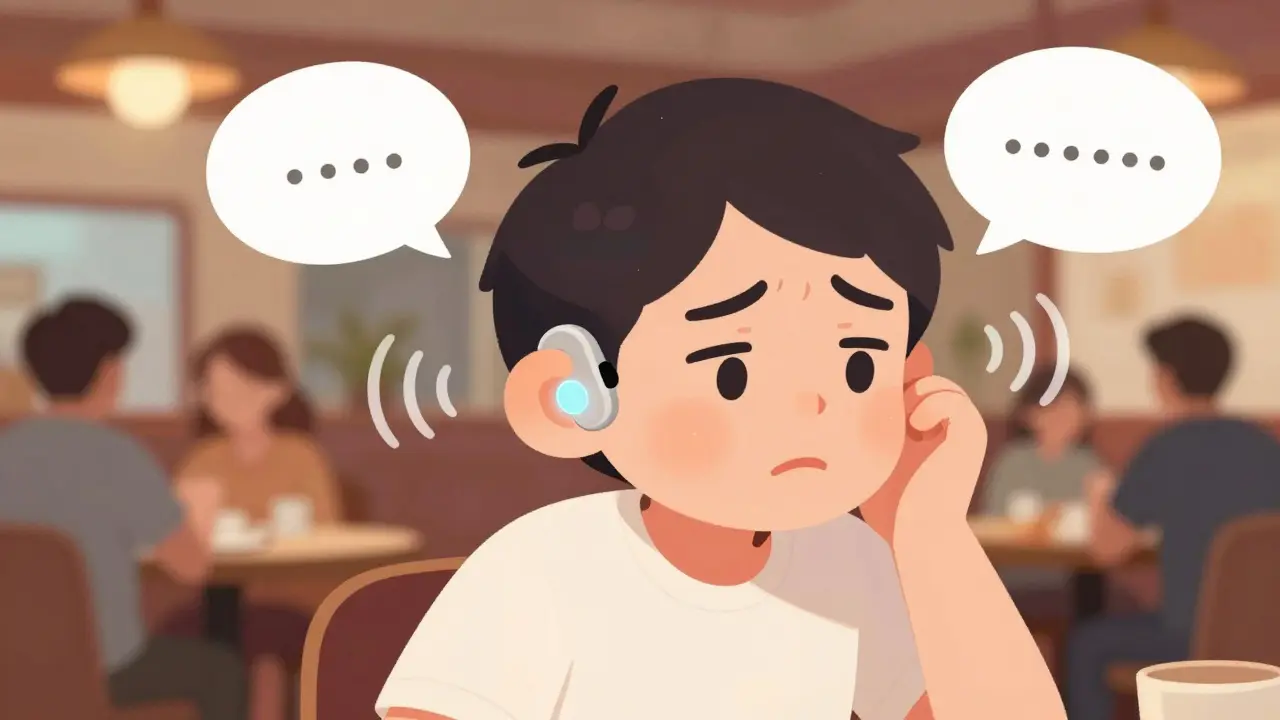
Imagine trying to follow a conversation in a busy restaurant, but no matter how hard you listen, voices coming from your left side sound muffled or disappear entirely. That’s the reality for people with single-sided deafness (SSD) - total or near-total hearing loss in one ear, with normal hearing in the other. It’s not just about missing sounds on one side. It’s about struggling to understand speech in noise, not knowing where sounds come from, and feeling constantly off-balance in social settings. Around 4 to 5 out of every 100,000 people develop SSD each year, and while it’s rare, the impact is huge. The good news? Two main technologies - CROS hearing aids and bone-anchored devices - can help. But they work in completely different ways, and choosing between them isn’t as simple as picking the cheaper option.
What Is Single-Sided Deafness, Really?
Single-sided deafness isn’t just having one ear that’s a little worse than the other. It means one ear has hearing loss so severe that it can’t process speech or sound at all - usually a pure-tone average worse than 70 dB HL. The other ear works normally or nearly so. This creates a problem called the head shadow effect. High-frequency sounds - like consonants such as “s,” “t,” and “f” - can’t bend around your head. So if someone speaks to your deaf side, those critical speech cues get blocked before they reach your good ear. The result? You hear voices, but you miss half the words.
People with SSD often report feeling isolated in group settings, constantly turning their head to catch what’s being said. Some notice it after an infection, a head injury, or sudden hearing loss. Others develop it slowly due to tumors like acoustic neuromas. The key point? Your brain still expects to hear from both sides. When one side goes silent, it doesn’t just lose volume - it loses spatial awareness. That’s why even a perfect hearing aid in your good ear doesn’t fix the problem.
CROS Hearing Aids: The Non-Surgical Option
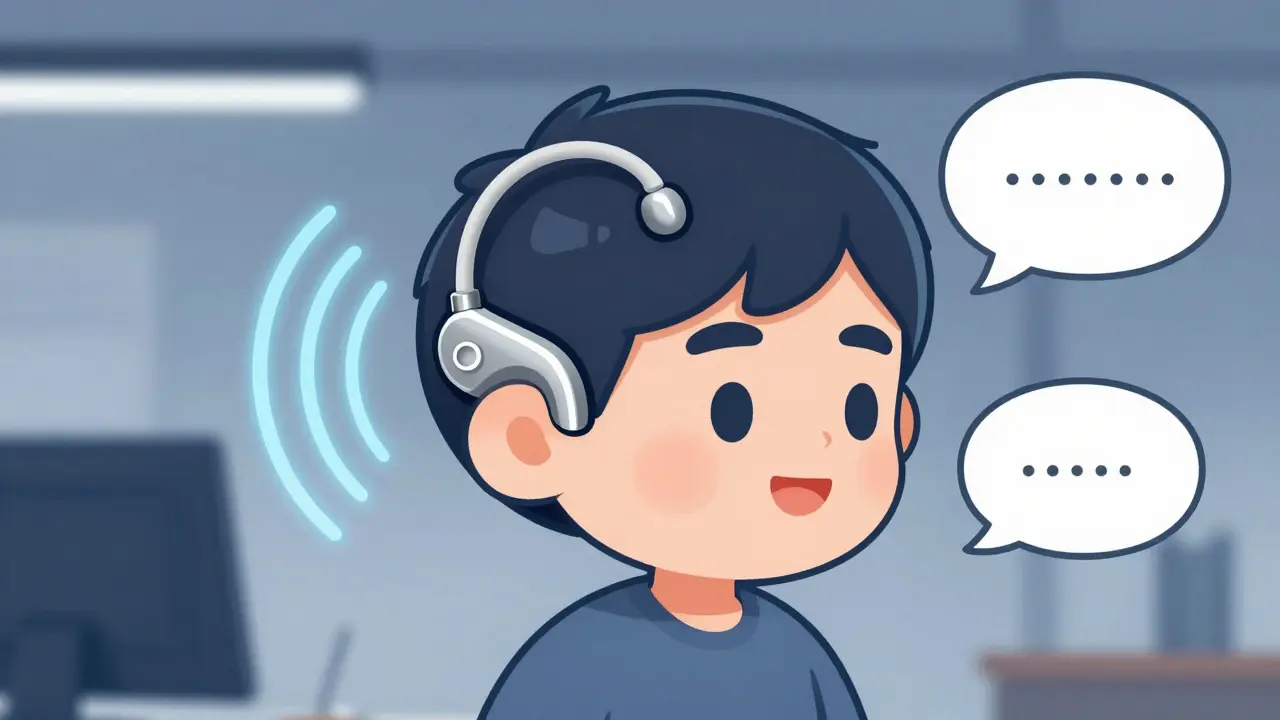
CROS stands for Contralateral Routing of Signals. It’s a system with two parts: a microphone on your deaf side and a hearing aid on your good side. The microphone picks up sound from your deaf ear and sends it wirelessly - usually via Bluetooth or magnetic signals - to the hearing aid on your better ear. It’s like having a radio transmitter on one side of your head and a speaker on the other.
Modern CROS devices, like Phonak CROS Marvel (2020), Oticon CROS Free (2021), and Signia CROS Pure 312 (2022), are sleek, wireless, and easy to use. They don’t require surgery. You can try them for two weeks before buying. If you’re not comfortable with anything going into your body, this is your starting point. They’re also cheaper - around $2,500 to $4,000 for the pair.
But here’s the catch: CROS doesn’t restore true binaural hearing. It just moves sound from one side to the other. That means:
- Voices from your deaf side sound like they’re coming from inside your good ear - unnatural and confusing.
- In noisy places, like a café or office, the system picks up all the background noise from your deaf side and sends it to your good ear. That can make speech harder to understand, not easier.
- Battery life is short. Most need replacing every 2 to 3 days.
- Some users report that the extra noise from the deaf side makes conversations worse.
A 2022 study tracking 13 CROS users found that nearly half (46%) stopped using their devices after a year. Why? Because the benefit didn’t match the expectation. People thought they’d hear like they used to. Instead, they got a constant stream of noise from the wrong side.
Bone-Anchored Hearing Devices: The Surgical Route
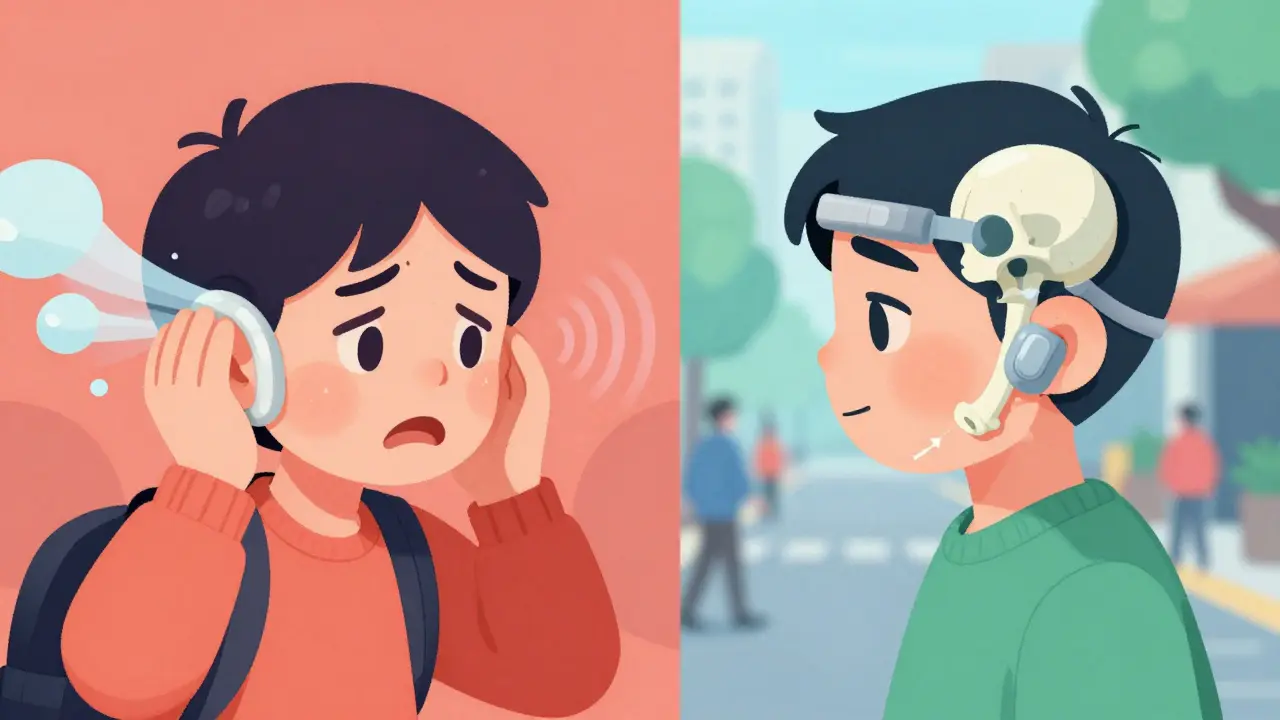
Bone-anchored hearing devices - or BAHDs - work differently. Instead of sending sound through the air, they send vibrations directly through your skull bone to your inner ear. Think of it like tapping your skull with your finger and hearing the buzz. That’s what these devices do, but with precision.
There are two types: percutaneous and transcutaneous. Percutaneous systems - like the Cochlear Baha 6 Max - use a titanium implant screwed into the skull behind the ear. After 3 to 6 months of healing, the sound processor clips onto the implant. Transcutaneous systems - like Oticon Medical Ponto 5 SuperPower - use magnets to hold the processor against the skin, skipping the external post.
These devices bypass the ear canal entirely. That means no earwax buildup, no occlusion effect (that plugged-up feeling you get with traditional hearing aids), and better wind noise resistance. Sound quality is often described as more natural because vibrations travel through bone the same way your inner ear naturally receives them.
But there’s a trade-off: surgery. The procedure takes about 45 minutes under local anesthesia. Costs range from $7,000 to $15,000 total - including implant, processor, and surgery. Recovery isn’t quick. You’ll need to keep the area clean to avoid skin infections, which happen in 15% to 63% of percutaneous users. Some need antibiotic cream monthly. Still, 93% of BAHD users stick with it long-term, compared to just over half of CROS users.
Studies show BAHDs reduce the head shadow effect by 8 to 10 dB - similar to CROS - but they perform better in noisy environments. In one test, when noise came from the deaf side and speech from the good side, CROS users understood 1.2 dB worse than when they weren’t wearing anything. BAHD users didn’t have that problem.
Performance Comparison: What the Data Shows
It’s not just about how loud things get. It’s about clarity, comfort, and long-term use.
| Feature | CROS Hearing Aid | Bone-Anchored Device (BAHD) |
|---|---|---|
| How it works | Wirelessly transmits sound from deaf ear to good ear | Vibrates skull bone to stimulate inner ear |
| Surgery required? | No | Yes (implant or transcutaneous system) |
| Cost (2026 estimate) | $2,500 - $4,000 | $7,000 - $15,000 (including surgery) |
| Battery life | 2-3 days (size 13/312) | 5-7 days (size 675) |
| Best for | Normal hearing in good ear, no surgery preference | Mild-moderate hearing loss in good ear, long-term solution |
| Sound quality | Can sound unnatural; voices seem inside head | More natural; no occlusion effect |
| Wind noise | Problematic | Minimal |
| Long-term use rate | ~54% abandon after 1 year | ~93% continue after 1 year |
| Common complaints | Battery life, noise interference, unnatural sound | Skin irritation, surgery risk, cost |
One of the biggest surprises? CROS can actually make speech understanding worse in certain situations. When noise comes from the deaf side - like a car honking behind you - the CROS system sends all that noise to your good ear. Your brain can’t filter it out. In those cases, you understand less than if you weren’t wearing anything at all. BAHDs avoid this because they don’t rely on air conduction. They deliver sound directly to the bone, so background noise from the deaf side doesn’t flood your good ear.
Who Should Choose What?
There’s no one-size-fits-all answer. But here’s how to think about it:
- Choose CROS if: You have normal hearing in your good ear, you’re not ready for surgery, you want to try something reversible, and you’re okay with changing batteries every few days. It’s a good first step - especially if you work in quiet environments.
- Choose BAHD if: You have mild hearing loss in your good ear (up to 45 dB HL), you’re active, you hate the feeling of something blocking your ear canal, and you’re willing to manage a small surgical site. You’ll likely get better results in noisy places and over the long term.
Some people try CROS first. If it doesn’t help enough - especially in restaurants, meetings, or traffic - they move to BAHD. That’s now the recommended clinical path. The FDA updated its guidelines in January 2024 to reflect this stepped approach: trial CROS for at least 4 weeks, then consider BAHD if results are poor.
The Future: Where Do We Go From Here?
The field is changing fast. Cochlear implants - once only for total deafness - are now being used for SSD. A 2023 trial showed CI users had 30% better sound localization than BAHD users. The FDA approved CI for SSD in early 2024. But it’s still invasive, expensive, and not for everyone.
Meanwhile, CROS tech keeps improving. Signia’s 2023 model includes built-in tinnitus therapy. Phonak’s latest uses AI to reduce background noise. But the core problem remains: CROS can’t restore true binaural hearing.
Bone-anchored systems are getting smarter, too. The Cochlear Baha 7 Smart (2024) now uses AI to adjust noise filtering automatically. Transcutaneous systems are reducing skin issues. And costs? They’re slowly coming down.
One thing’s clear: the best solution depends on your life. If you’re a teacher who needs to hear students on both sides of the room, BAHD might be worth the surgery. If you’re a retiree who mostly talks face-to-face, CROS might be enough. But if you’re in construction, driving daily, or in loud offices - don’t settle for CROS. It won’t protect you from noise overload.
What Experts Say
Dr. John P. Kelly from the University of Washington puts it simply: “CROS gives you sound. BAHD gives you hearing.”
Dr. David Jung from Harvard adds: “Patients who abandon CROS aren’t failing the device. They’re failing the expectation that it would feel normal. It doesn’t. It just redirects.”
And Dr. H. Gustav Mueller from Vanderbilt warns: “Don’t skip the trial. If you’re not sure, try CROS first. But if you’re still struggling after a month, don’t wait. Move on.”
The bottom line? Single-sided deafness isn’t a minor issue. It affects how you connect, work, and feel safe. And while neither CROS nor BAHD restores normal hearing, one of them can give you back your confidence - if you pick the right one.
Can CROS hearing aids restore normal hearing?
No. CROS systems don’t restore binaural hearing. They simply move sound from the deaf side to the good side. You still hear with only one ear. This means you won’t regain the ability to locate sounds naturally or filter out background noise the way someone with two healthy ears can. The brain adapts to the redirected signal, but it never creates true stereo hearing.
Is bone-anchored surgery risky?
The surgery is generally safe and done under local anesthesia. But risks include infection at the implant site, skin irritation, and poor bone integration. About 15% to 63% of users experience skin reactions, especially with percutaneous systems. Most can be managed with cleaning and topical creams. Serious complications like bone loss or implant failure are rare - under 5% in long-term studies. Always choose a center experienced in bone-anchored procedures.
Can I try CROS before buying?
Yes. Most providers offer a 2- to 4-week trial period with no obligation. This is critical. Many users think CROS will fix everything, but in real life, it can make noisy environments harder. The trial lets you test it in your daily life - at work, in traffic, with friends - before committing.
Do I need a CT scan before getting a bone-anchored device?
Yes. A CT scan is required to measure bone thickness and density behind the ear. The skull must be at least 3.5 mm thick to support the implant. If the bone is too thin or irregular, the device won’t integrate properly, and the implant could fail. This step ensures safety and long-term success.
Can children use CROS or bone-anchored devices?
CROS hearing aids can be used in children as young as 5, but bone-anchored devices are typically only approved for children 5 and older with fully developed skull bones. Implantation before age 5 is rare and only done in extreme cases. Children with SSD often benefit more from BAHDs because they’re more stable during play and school activities.
How long does it take to adapt to a bone-anchored device?
It takes 4 to 8 weeks to fully adapt. Unlike CROS, which feels like a simple audio switch, bone conduction sounds strange at first - like your voice is echoing in your head. Your brain needs time to reinterpret these vibrations as normal sound. Most users report significant improvement after 6 weeks, with full adaptation by 3 months.
Can I swim or shower with a bone-anchored device?
Yes - but only if you remove the processor. The external sound processor is not waterproof. However, the implant itself is safe under water. After swimming or showering, dry the skin around the abutment thoroughly to prevent infection. Transcutaneous systems (magnetic) are slightly more water-resistant but still require removal before water exposure.
Are CROS and BAHD covered by insurance?
CROS hearing aids are often covered by private insurance as standard hearing aids. BAHDs are more complex. Medicare and many private insurers cover the device and surgery if deemed medically necessary, but out-of-pocket costs can still reach $3,000-$7,000. Always check with your provider. VA hospitals now cover BAHD for eligible veterans following a 2021 pilot program.
Can I upgrade my CROS device later if I switch to BAHD?
Yes, but you won’t get your money back. Most manufacturers don’t offer trade-ins. However, if you bought a CROS system through a clinic, ask if they’ll apply its cost toward a BAHD purchase. Some do, especially if you switch within 6 months. But don’t count on it. Plan your purchase as a long-term decision.
What’s the difference between BAHD and a cochlear implant for SSD?
BAHD uses your existing inner ear - it just delivers sound through bone. A cochlear implant bypasses the inner ear entirely and directly stimulates the auditory nerve. For SSD, CI is only recommended if you’ve tried CROS and BAHD and still struggle with spatial hearing. CI gives better sound localization but is more invasive and expensive. It’s not a first-line option - more like a last resort after other options fail.
If you’re dealing with single-sided deafness, you’re not alone. And you don’t have to accept the silence. Whether you choose the non-invasive path of CROS or the deeper solution of a bone-anchored device, the right option can bring you back into conversations, back into your world - one sound at a time.






Comments(16)