
Have you ever said something in a conversation and later realized it had nothing to do with what the other person actually said? Or noticed how quickly you dismiss an opinion just because it doesn’t match what you already believe? That’s not just a bad conversation-it’s your brain following a hidden script. These scripts are called cognitive biases, and they’re the invisible forces shaping almost every response you give, every decision you make, and every belief you defend.
It’s not that we’re bad thinkers. We’re just built to take shortcuts. Back in our ancestral past, speed saved lives. If you heard rustling in the grass, you didn’t pause to analyze whether it was a snake or the wind-you reacted. Today, that same instinct kicks in when someone challenges your political view, your parenting style, or even your favorite brand. Your brain doesn’t weigh facts. It looks for confirmation. And that’s where things go wrong.
How Your Beliefs Twist Your Responses
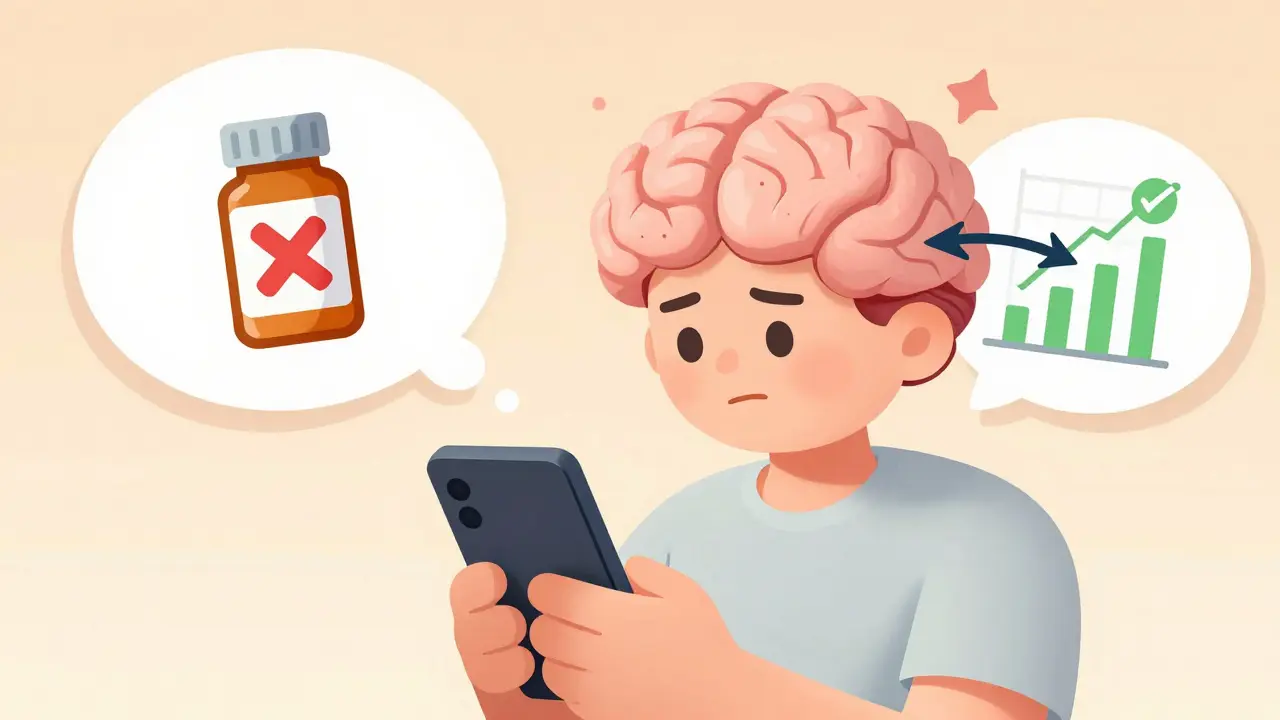
Imagine you’re scrolling through social media and come across a post claiming that a certain medication causes long-term side effects. You’ve been taking that medication for years. Without thinking, you scroll past it, muttering, “That’s not true.” Why? Not because you checked the science. Not because you read the study. You just felt it clashed with your belief-and your brain shut it down. This is confirmation bias in action.
Confirmation bias isn’t just about ignoring facts. It’s about actively filtering reality to protect your worldview. A 2021 meta-analysis found it has the strongest effect size of any cognitive bias when it comes to shaping responses, with a score of d=0.87. That means, in controlled experiments, people are nearly twice as likely to accept information that fits their beliefs and reject what doesn’t-even when the evidence is solid.
It doesn’t stop there. When you’re wrong, your brain doesn’t just ignore the mistake. It rewrites history. That’s hindsight bias. You say, “I knew that was going to happen,” even if you were completely unsure before. A 1993 study showed that when students were asked to predict U.S. Senate votes, 57% later claimed they’d been sure of the outcome-even though they hadn’t been. Your memory doesn’t record truth. It records what feels right now.
The Invisible Lines We Draw Between People
Ever noticed how you judge yourself differently than you judge others? You’re late to a meeting because traffic was bad. Your coworker is late, and you think, “They’re just irresponsible.” That’s the fundamental attribution error. You give yourself the benefit of the doubt. Everyone else gets the worst interpretation.
And it gets worse. When it comes to people outside your group-whether it’s a different political party, nationality, or even just a different office-you react more emotionally. Pollack Peacebuilding’s 2023 data found that people show 37.8% stronger emotional responses when evaluating actions by out-group members. That’s not just unfair. It’s automatic. Your brain treats them as less human, less trustworthy, less worthy of understanding.
Then there’s the false consensus effect. You think everyone agrees with you. A 1987 study across 12 countries found people overestimate agreement with their own beliefs by over 32 percentage points. You post a hot take on Twitter, get 200 likes, and assume the world sees it your way. But half of those who didn’t react? They’re still out there, quietly disagreeing.
Why We Believe We’re Less Biased Than Everyone Else
Here’s the twist: you think you’re the exception. In a 2002 study, 85.7% of participants rated themselves as less biased than their peers. That’s not just optimism. It’s a blind spot so deep, it’s called the bias blind spot. You can spot bias in others. You can’t see it in yourself.
Dr. Mahzarin Banaji’s research using the Implicit Association Test showed that 75% of people hold unconscious biases that directly contradict their stated values. Someone who says they believe in equality might still react slower when pairing positive words with Black faces than with white faces. Their words say one thing. Their brain says another. And they have no idea.
Even experts aren’t immune. Doctors, judges, financial advisors-they all fall prey. Johns Hopkins Medicine found that 12-15% of diagnostic errors in healthcare are tied to cognitive bias. A doctor sees a patient with chest pain, remembers a similar case last week that turned out to be heartburn, and dismisses the possibility of a heart attack. It’s not malpractice. It’s mental laziness.
How Beliefs Cost Real Money and Lives
This isn’t just about feeling misunderstood. It’s about real consequences.
In finance, optimism bias leads people to underestimate their risk of losing money by 25.6%. A 2023 Journal of Finance study tracked 50,000 retail investors and found those with the strongest optimism bias earned 4.7 percentage points less per year than those who were more realistic. That’s not a small gap. Over 10 years, it could mean hundreds of thousands of dollars lost.
In the legal system, eyewitness misidentification-driven by expectation bias-played a role in 69% of wrongful convictions later overturned by DNA evidence, according to the Innocence Project. A witness sees a suspect in a lineup, remembers the face from the news, and picks the one who looks most familiar-not the one who was actually there.
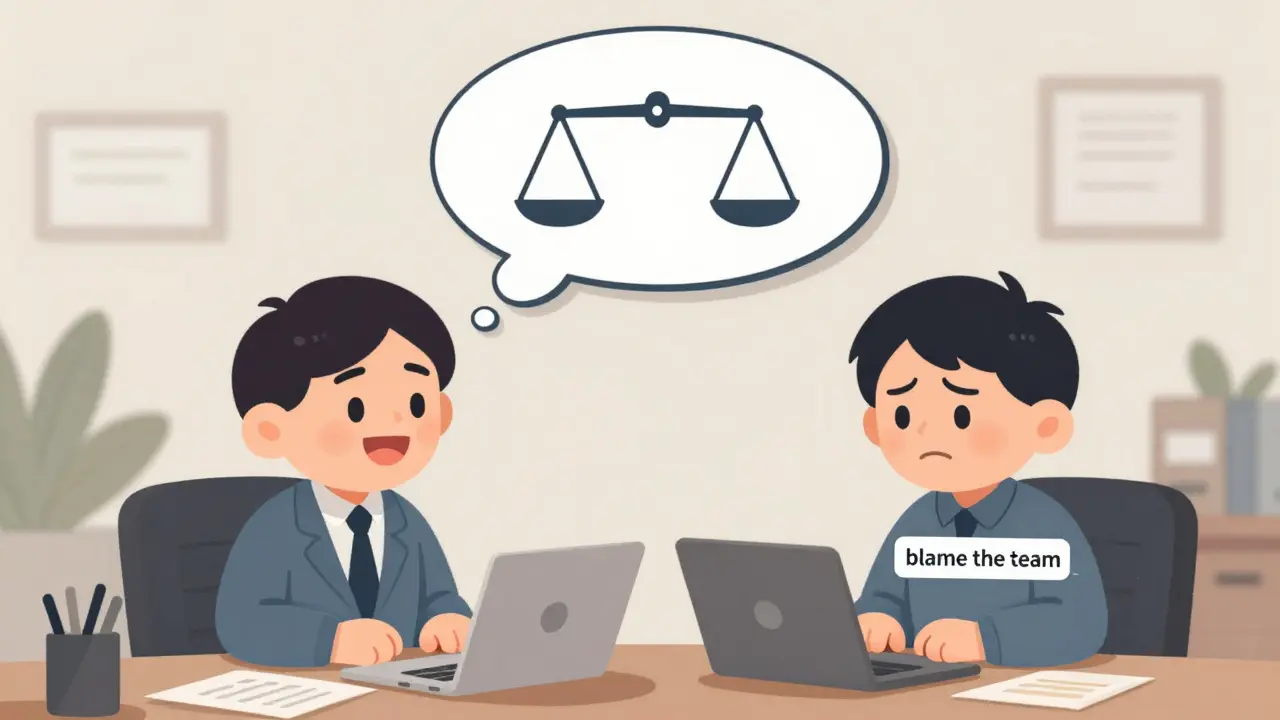
And in workplaces? Managers with strong self-serving bias-who take credit for wins and blame failures on “the market” or “the team”-have 34.7% higher team turnover, according to a Harvard Business Review study. People don’t quit because of low pay. They quit because they feel unseen, unheard, and unfairly judged.
Can You Actually Fix This?
Yes-but not by trying harder. Not by saying, “I’ll be more open-minded.” That’s like telling someone with a broken leg to just walk more carefully.
The real fix is structure. You need systems that force your brain to pause.
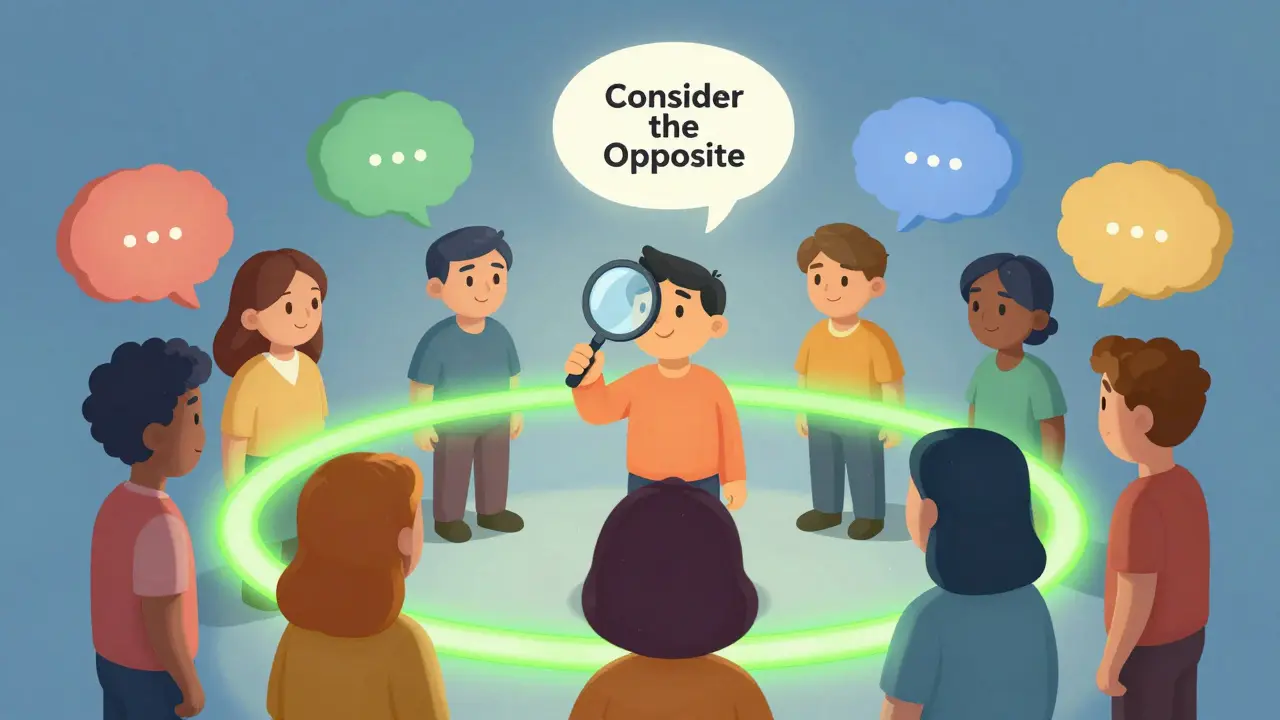
One proven method is the “consider-the-opposite” strategy. Before you respond to something you disagree with, write down three reasons why it might be right. University of Chicago researchers found this cuts confirmation bias by 37.8%. It’s not about changing your mind. It’s about giving your brain space to breathe.
Medical teams now use mandatory checklists: before finalizing a diagnosis, they must list three alternative explanations. In 15 teaching hospitals, this simple rule reduced diagnostic errors by 28.3%. It’s not magic. It’s just forcing slow thinking to kick in.
There’s also Cognitive Bias Modification (CBM), a technique backed by 17 clinical trials. After 8-12 weeks of 45-minute sessions, people showed a 32.4% reduction in belief-driven responses. Tools like IBM’s Watson OpenScale now monitor AI decisions in real time, flagging when responses lean too heavily on biased patterns. Companies using it cut bias in algorithmic decisions by 34.2%.
And now, governments are stepping in. The European Union’s AI Act, effective February 2025, requires all high-risk AI systems to be tested for cognitive bias. The FDA approved the first digital therapy for bias modification in 2024. Even schools are starting to teach it. As of 2024, 28 U.S. states require cognitive bias literacy in high school curricula.
What You Can Do Today
You don’t need a PhD or a corporate training program. Start small.
- Before replying to a heated comment, wait 10 seconds. Ask: “What’s one reason this person might be right?”
- When you hear a news headline, Google the study behind it. Not the blog post. Not the tweet. The original paper.
- Keep a “bias log.” For one week, write down every time you dismissed something because it felt “obviously wrong.” Then, revisit it later. You’ll be surprised how often you were wrong.
- Surround yourself with people who disagree with you-not to argue, but to listen. Real growth happens in discomfort.
Beliefs aren’t the enemy. They’re useful. But when they become shields instead of guides, they blind us. The goal isn’t to eliminate belief. It’s to make space for truth-even when it’s uncomfortable.
Are cognitive biases the same as stereotypes?
No. Stereotypes are generalizations about groups of people-like assuming all teenagers are reckless. Cognitive biases are mental shortcuts that affect how you process information, whether it’s about people, numbers, or events. A stereotype can be fueled by a bias (like in-group/out-group bias), but biases operate on a deeper, more automatic level. You can hold a stereotype without being biased, and you can be biased without holding any stereotypes.
Can you completely eliminate cognitive biases?
No-and you shouldn’t try. Biases evolved to help us survive. The goal isn’t to remove them, but to recognize them before they control you. Think of it like driving: you don’t eliminate gravity, but you use seatbelts and brakes to manage it. Same here. Awareness and structure are your seatbelts.
Do cognitive biases affect AI and technology?
Yes, and dangerously so. AI systems learn from human data-and humans are biased. If a hiring algorithm is trained on resumes from a company where men were promoted more often, it will learn to favor men. Google’s Bias Scanner and IBM’s Watson OpenScale exist to catch these patterns. The EU’s AI Act now requires bias testing for all high-risk AI systems. Technology doesn’t think. It mirrors us.
Why do people resist learning about cognitive biases?
Because admitting you’re biased feels like admitting you’re flawed. Most people think bias is for “other people”-the irrational ones. The bias blind spot makes us believe we’re immune. That’s why training programs often fail: they start with shame instead of curiosity. The most effective approaches treat bias like a habit-not a moral failing.
How long does it take to reduce the impact of cognitive biases?
Studies show measurable improvement after 6-8 weeks of consistent practice. A 2022 study tracking 450 people found that those who practiced “consider-the-opposite” daily for two months reduced their belief-driven responses by 30%. Like learning a language or building muscle, it takes repetition. One article won’t change you. Daily habits will.
Next Steps: What to Do If You Want to Improve
If you’re serious about reducing how much your beliefs distort your responses, start with one thing: pause before you react. Whether it’s in a text, a meeting, or a comment section, give yourself five seconds to ask: “Is this my belief talking-or the facts?”
Then, pick one bias to track this week. Confirmation bias? Self-serving bias? The fundamental attribution error? Write down three times it showed up. You’ll be shocked how often it happens.
And don’t wait for a training program or an app. The best tool you have is already in your hands: your awareness. You don’t need to be perfect. You just need to be curious.


Comments(15)