

When your stomach suddenly locks up in sharp, unrelenting pain-right under your ribs on the right side-it’s easy to blame food poisoning or indigestion. But if this happens more than once, especially after eating fatty meals, and the pain lasts hours instead of minutes, you might be dealing with gallstones. These aren’t just tiny pebbles floating around. They’re solid deposits formed in your gallbladder, and when they block the flow of bile, they trigger serious problems like biliary colic and cholecystitis. Left untreated, they can lead to emergency surgery, infection, or even pancreatitis. The good news? There’s a clear, proven path forward for most people: surgery. And it’s safer and more effective than ever.
What Happens When Gallstones Block the Flow
Gallstones form when bile-your liver’s digestive fluid-gets out of balance. Too much cholesterol, too little bile salts, or a gallbladder that doesn’t empty properly can cause crystals to harden into stones. About 80% of these are cholesterol stones; the rest are made of bilirubin, a waste product from broken-down red blood cells. In the U.S., 10-15% of adults have them. But here’s the twist: 80% of those people never feel a thing. They live their whole lives unaware they have gallstones. Symptoms start when a stone gets stuck. Not permanently-just long enough to cause trouble. That’s biliary colic. The pain hits fast, usually after a heavy meal, and it doesn’t let up. It’s steady, not crampy. It’s not relieved by burping, pooping, or vomiting. It’s centered in the upper right abdomen, sometimes radiating to the right shoulder or back. Episodes last 1 to 5 hours, then fade as the stone shifts. This isn’t gas. It’s your gallbladder screaming because it’s trapped. The American Academy of Family Physicians found that over 90% of people who have one episode of biliary colic will have another within 10 years. Two-thirds will be back in pain within two years. That’s not bad luck-it’s the natural progression of untreated stones.When Biliary Colic Turns Into Cholecystitis
If a stone blocks the cystic duct for more than a few hours, the gallbladder starts to swell and get inflamed. That’s acute cholecystitis. It’s not just pain anymore. You’ll likely have a fever, nausea, vomiting, and tenderness so bad you can’t even take a deep breath. The skin around your right side may turn yellow (jaundice) if the stone moves into the common bile duct. This is a medical emergency. About 20% of people with biliary colic will develop cholecystitis. And if you’ve had one attack, your risk keeps climbing. The NHS reports that 20-30% of people with untreated symptomatic gallstones end up in the hospital for an emergency within five years. That’s not a gamble worth taking. Doctors diagnose this with ultrasound-the gold standard. It’s quick, painless, and picks up stones with over 95% accuracy. Blood tests can show signs of infection or liver stress, but the picture is clear: if you’ve had biliary colic and now have fever and swelling, you’re not just having another episode. You’re in inflammation mode.The Only Real Solution: Cholecystectomy
There’s no magic pill that fixes this. Medications like ursodeoxycholic acid can dissolve small cholesterol stones-but only in 30-50% of cases, and it takes months. Even then, half the people who get relief see the stones come back within five years. Shockwave therapy? It works on single stones under 20mm, but recurrence is so high it’s rarely used anymore. The only treatment that reliably ends the cycle is removing the gallbladder. That’s cholecystectomy. And today, it’s almost always done laparoscopically. Instead of a big cut, surgeons make three or four tiny incisions. A camera and tools go in. The gallbladder is carefully detached and pulled out. The whole thing takes about 45 to 60 minutes. Laparoscopic surgery is the standard in the U.S.-90% of all gallbladder removals are done this way. Why? Because the benefits are undeniable. Hospital stays drop from nearly five days to just over one. Recovery time shrinks from a month to about a week. Pain is less. Scars are barely visible. The complication rate? Below 2% in experienced hands. The Society of American Gastrointestinal and Endoscopic Surgeons says if you’re diagnosed with acute cholecystitis, surgery should happen within 72 hours. Waiting increases the chance you’ll need open surgery-which means a bigger cut, longer recovery, and higher risk. Early surgery cuts that risk from 25% down to just 7%.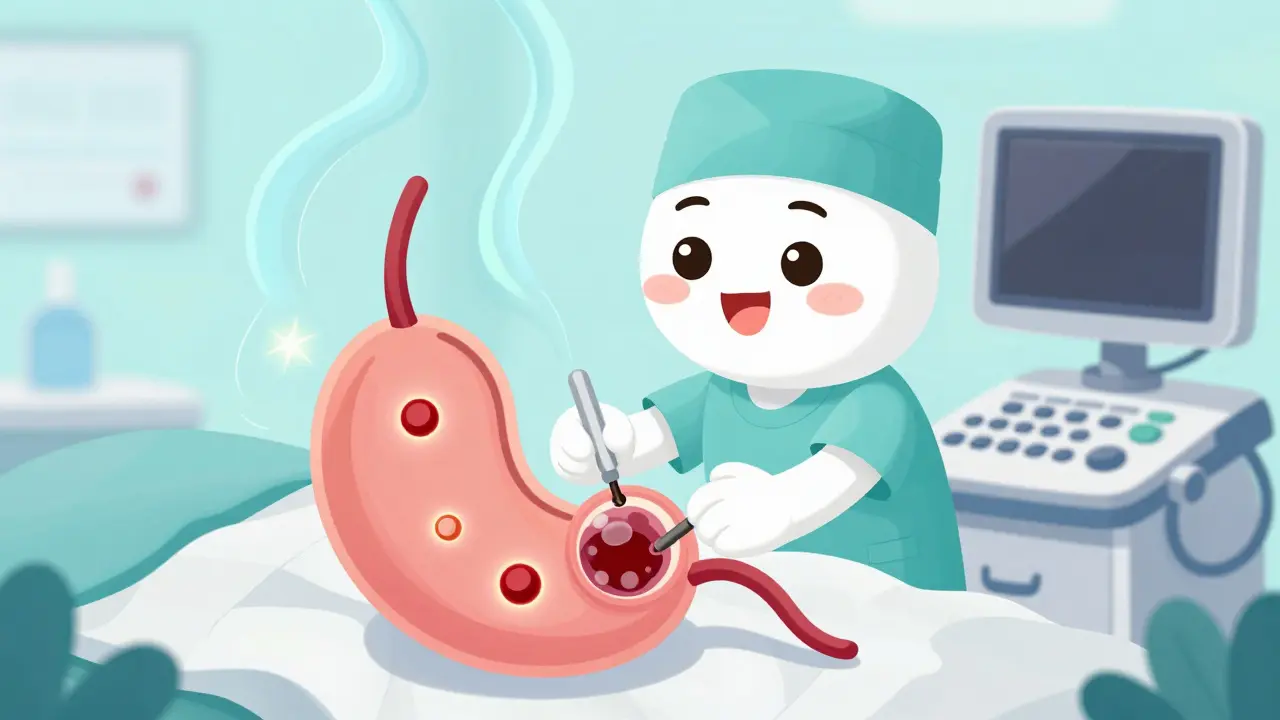
Who Should Avoid Surgery?
Most people benefit. But not everyone. Age and health matter. For healthy adults under 75, the risks of surgery are tiny compared to the risks of doing nothing. One study found that 64% of people who tried to avoid surgery ended up needing it within 5.6 years anyway. Why wait for the next attack to be worse? But for someone over 75 with heart disease, diabetes, or lung problems, surgery becomes riskier. Dr. Emily Finlayson from UCSF points out that 30-day mortality jumps from 0.1% in healthy patients to 2.8% in those with three or more chronic conditions. In these cases, doctors may opt for temporary drainage-using a needle to relieve pressure-or delay surgery until the patient is stronger. There’s also a new option gaining traction: endoscopic ultrasound-guided gallbladder drainage. The FDA approved it in 2023. It’s not a cure-it’s a bridge. It helps high-risk patients stabilize before deciding whether surgery is even possible. It’s not for everyone, but for those who can’t tolerate surgery, it’s a lifeline.What to Expect After Surgery
Most people go home the same day or the next morning. You’ll be up and walking within four hours. You’ll sip water within six. By day two, you’re eating light meals. No special diet is needed long-term. Your liver still makes bile-it just flows straight into your intestine instead of being stored. Some people notice looser stools or more frequent bowel movements for a few weeks. That’s normal. Your body adjusts. About 12% report ongoing diarrhea, and 6% develop post-cholecystectomy syndrome-persistent pain or bloating. But in most cases, that’s not from the surgery itself. It’s from other issues that were masked by the gallstones. A 2022 Healthline survey of over 1,200 patients found 78% felt their quality of life improved after surgery. One woman had 17 attacks over 18 months. After surgery, she was back to hiking within two weeks. No more pain. No more fear. No more missed work.Why So Many People Delay
The biggest problem isn’t the surgery. It’s the delay. Nearly half of patients in the Healthline survey saw three or more doctors before getting a correct diagnosis. Pain gets written off as “just indigestion.” Ultrasounds aren’t ordered right away. Emergency rooms give painkillers and send people home-without a plan. And when pain returns, many hope it’ll go away again. They don’t realize each episode increases the chance of complications. The data is clear: waiting doesn’t make surgery less necessary. It makes it more dangerous.



Comments(8)